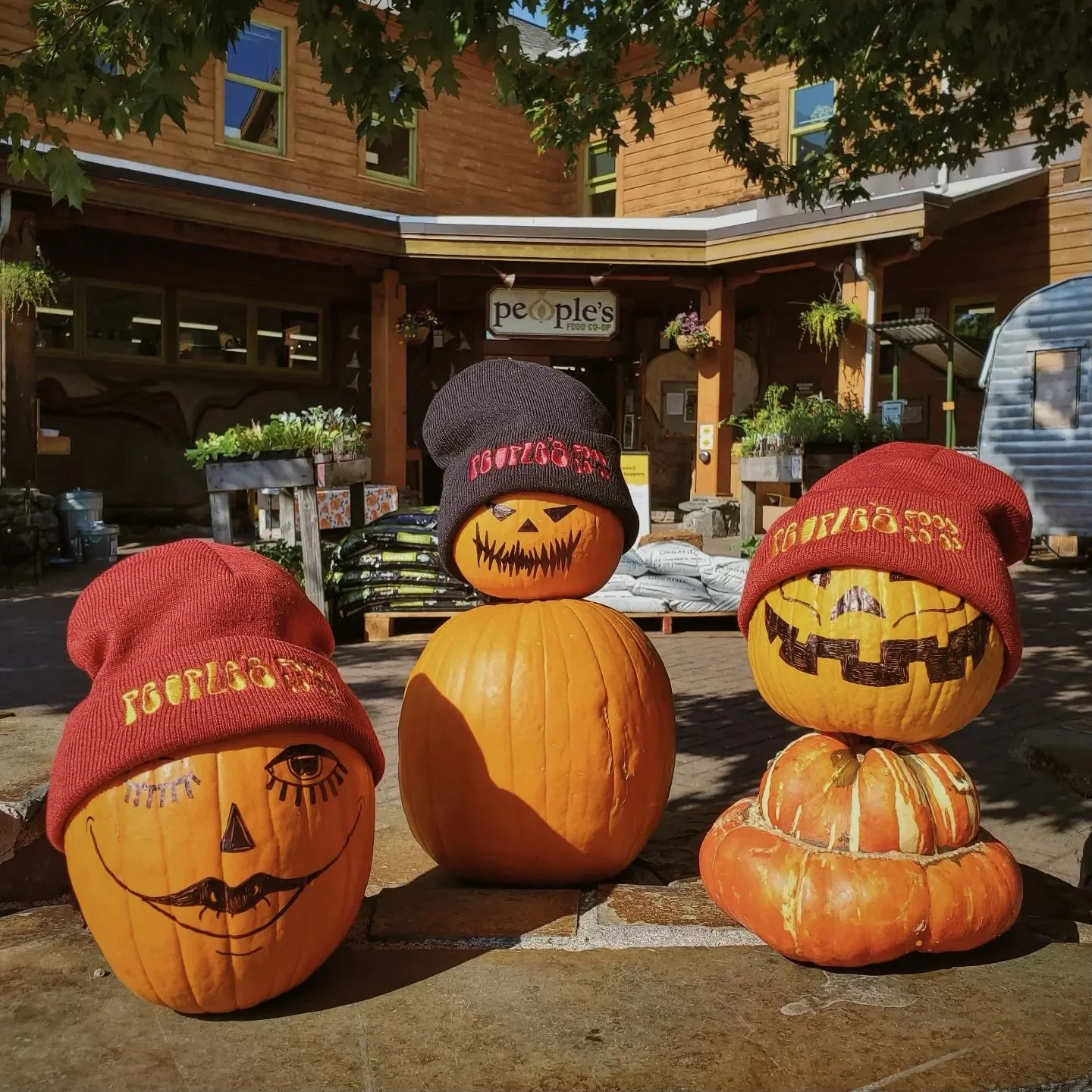
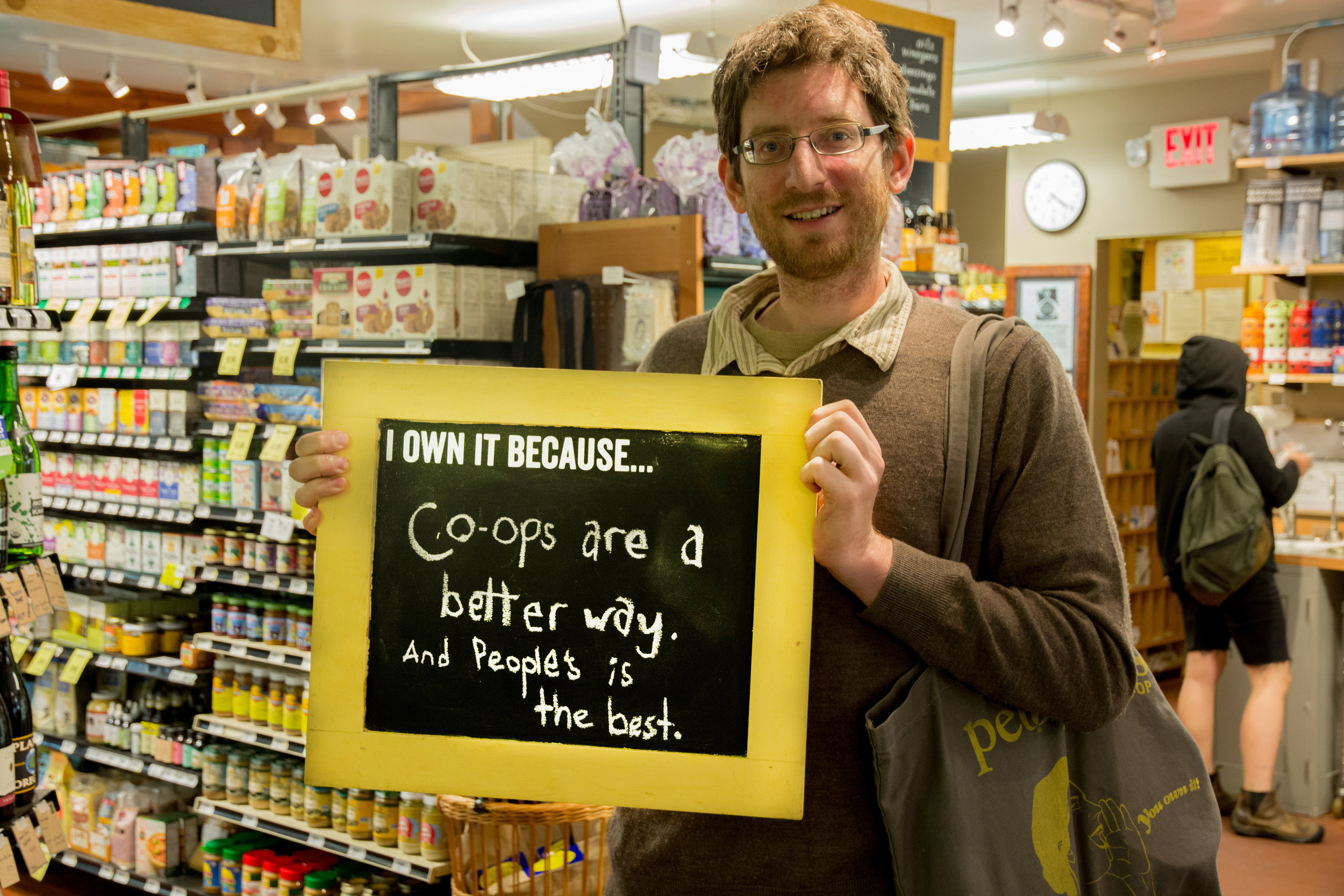
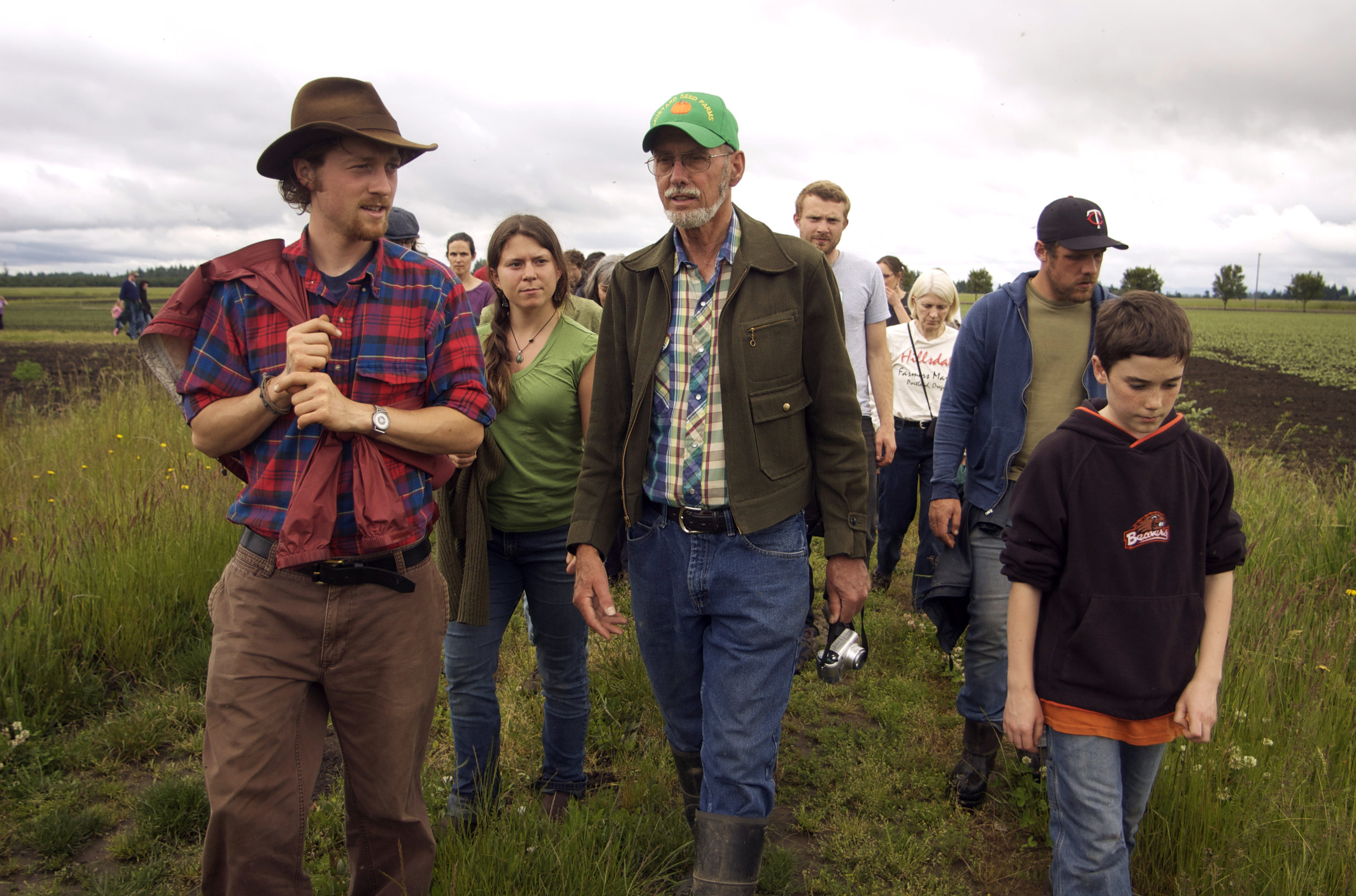
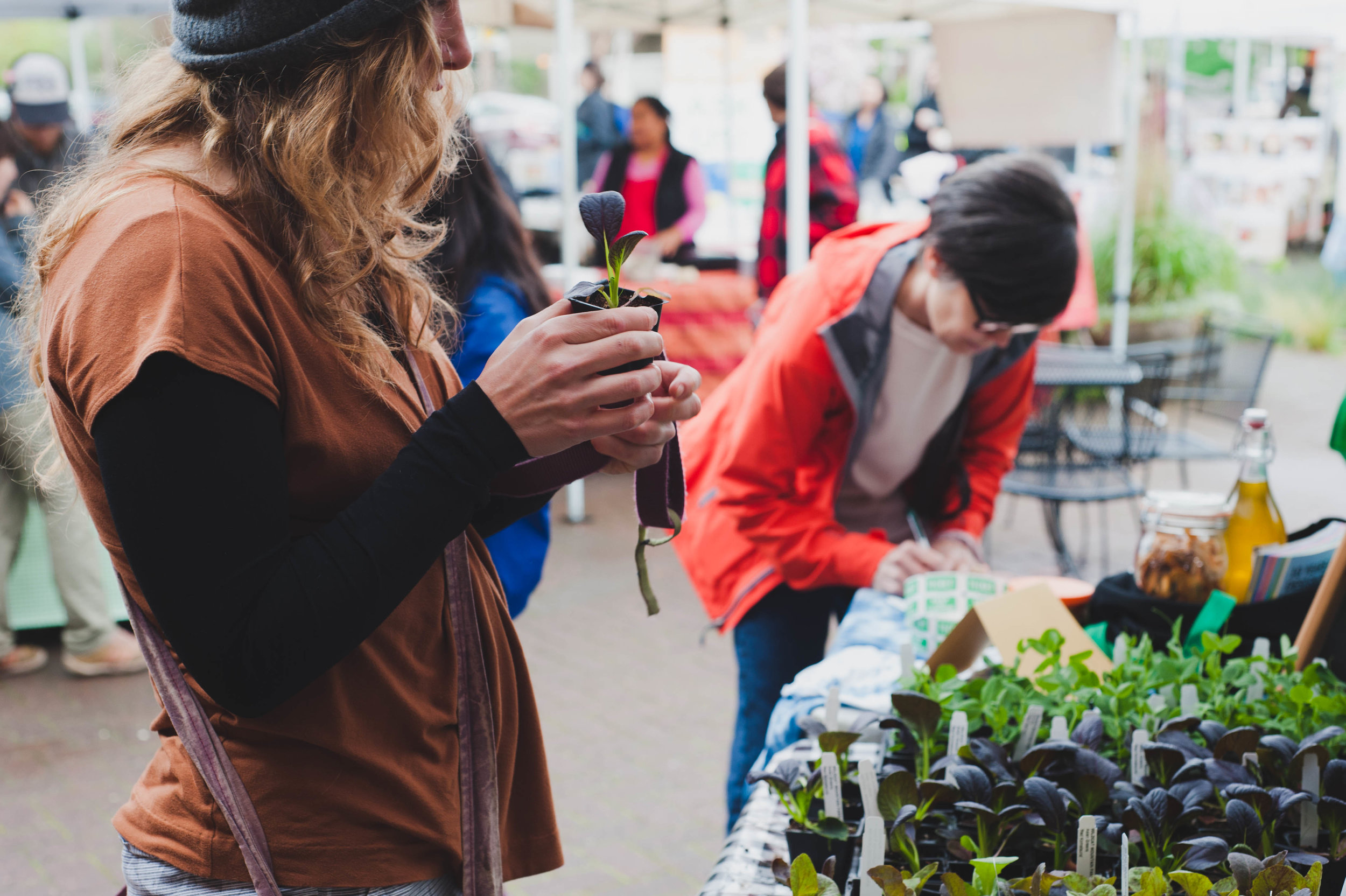
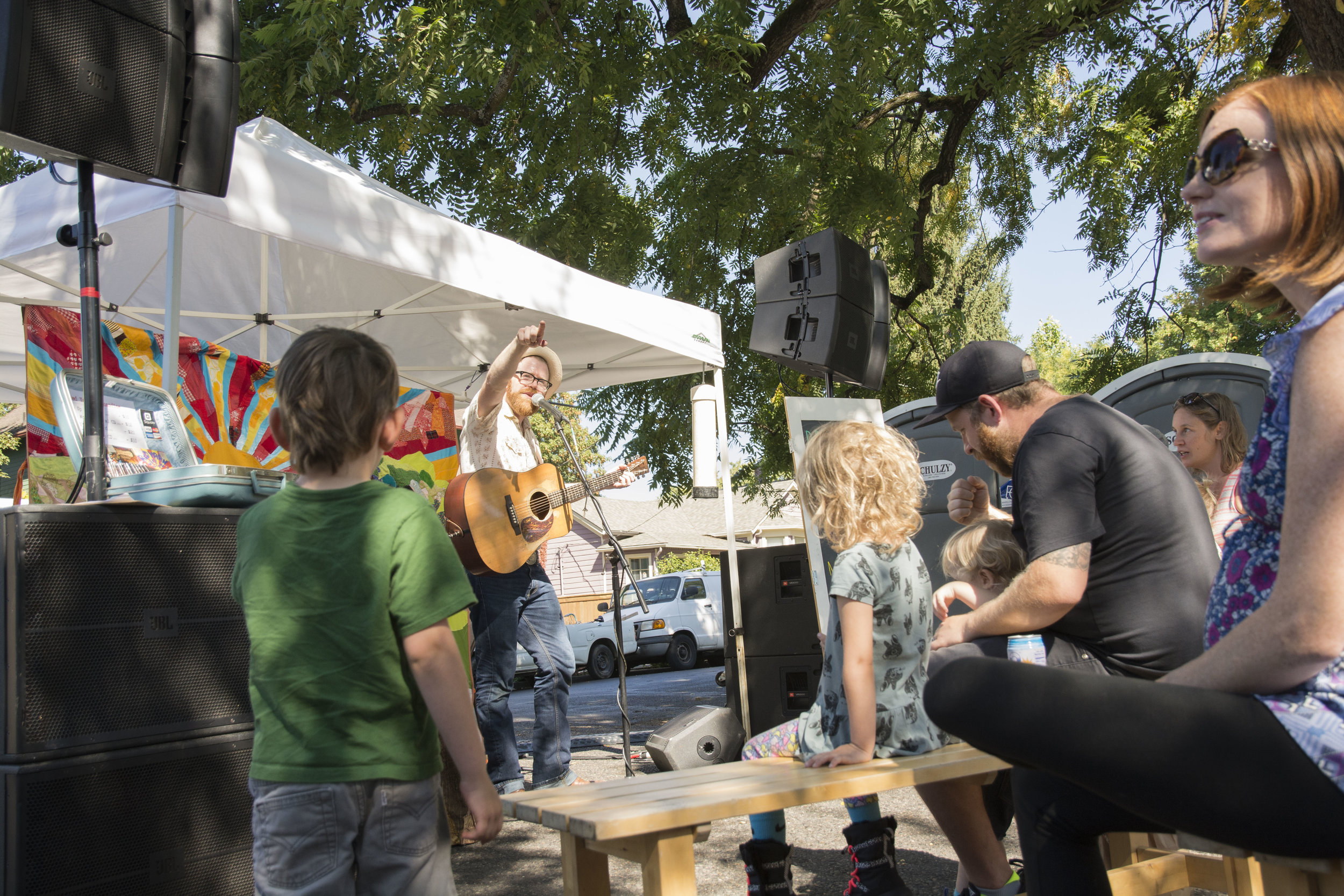
October is Co-op Month!

Own it this October!

It’s Co-op Month, the best time to invest!

Member-Owners are the reason that our Co-op exists. From the very beginning, People’s has been formed and molded by folks that saw a need to put in the time, work, and money to make this place get started and keep going. Member-Owner investments in the Co-op mean that we can tend to the needs of our space, our business, and our community.

We’re able to keep this special kind of business going because of all of the people that show up and invest in their belief in an alternative and the difference People’s offers. Every year during October, we take a moment to appreciate the work that we all do to keep this place going: whether that’s shopping, working, or purchasing a share of the Co-op.

To say thanks for being here, for investing, and for sharing this Co-op with us, there are some special incentives for investing in People’s:

incentives_onblue.jpg
  • Invest $15+: Equal Exchange Chocolate Bar + Reusable Stainless Steel Straw

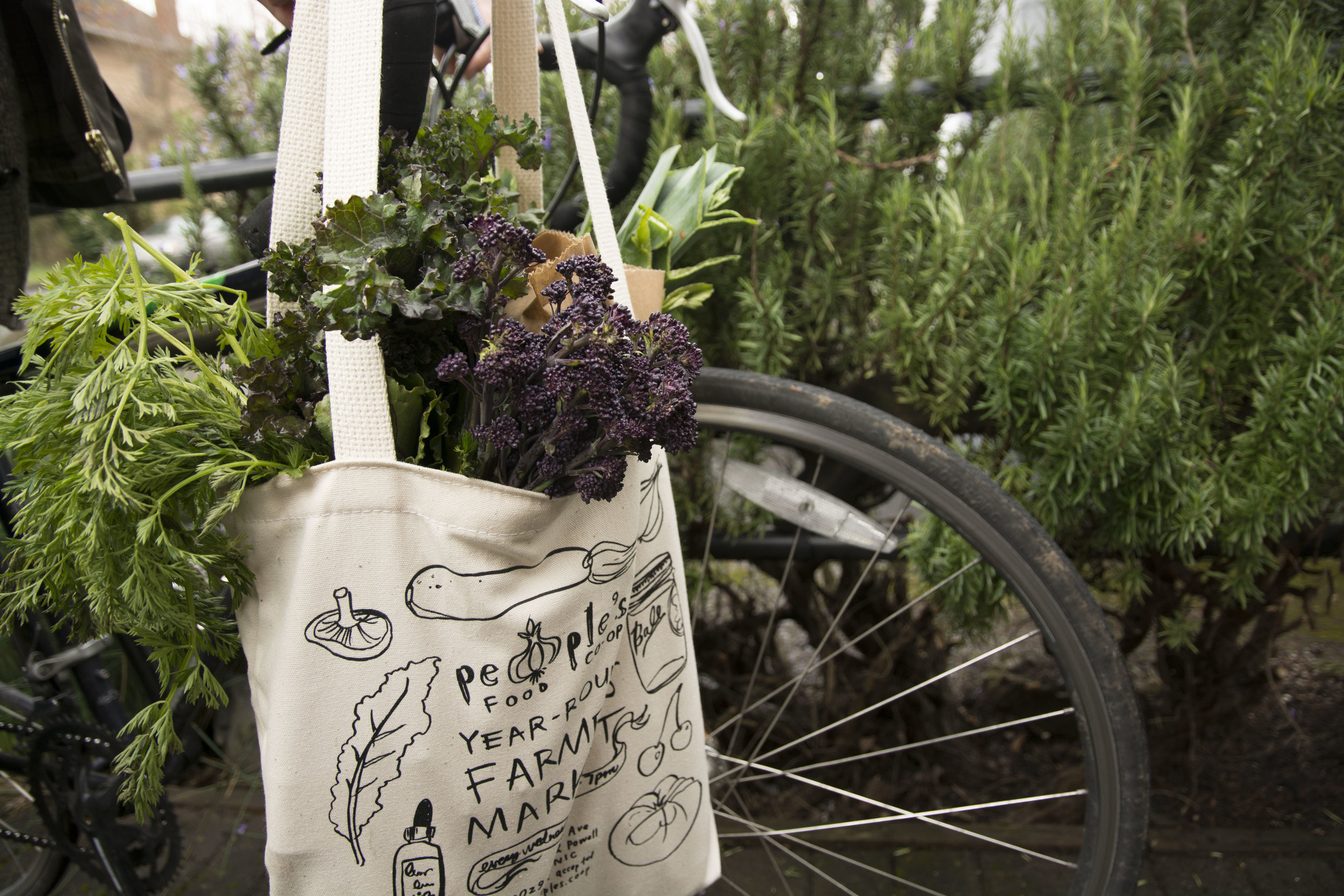
  • Invest $30+: Chocolate + Straw + Reusable Produce Bags designed by local artist Tess Rubinstein

  • Invest 60+: Chocolate + Straw + Produce Bags + Equal Exchange Palestinian Olive Oil

& Golden Tickets!

Three lucky Member-Owners will find a golden ticket in with their chocolate, straw, bags, or olive oil. If you find a golden ticket, you will get some amazing prizes:

Plus!

→ Be one of the first 50 folks to invest in your share, and you’ll get a free bottle of Dr. Bronner’s!

→ We’re having a 10% off sale on October 20th! Let’s celebrate Co-op Month by saving on all our favorites, and maybe even trying something new.

→ Join us for a screening of the film Food for Change all about the history of co-op’s in America on Saturday, October 13th at 7pm! We’ll have popcorn and time afterward for discussion.

→ Get to know other folks here! Come to the Co-op Community Potluck on Tuesday, October 30th at 6:30pm.

All you have to do to become a Member-Owner or invest in your share is to ask a cashier next time you are at the Co-op. It’s quick, convenient, and you’ll get to go home with a bunch of great stuff!

If you’ve already invested $180 (the full cost of a share), don’t worry! You can invest up to $300 in the Co-op and still get all of these great incentives. Those extra dollars mean a lot here!

Invest & Win: Bags from North St.!

This Co-op Month, we are thrilled to be offering a few special prizes for folks that become a Member-Owner or make an investment in their share throughout the month of October. There are already some great incentives for investing this month (you can read more about them here), but in with the chocolate bars, reusable produce bags, and other prizes will be three golden tickets: one for a skillet from Finex, another for a People’s tote bag stuffed full of our favorite fall essentials, and another for a pair of bags from North St. Bags.

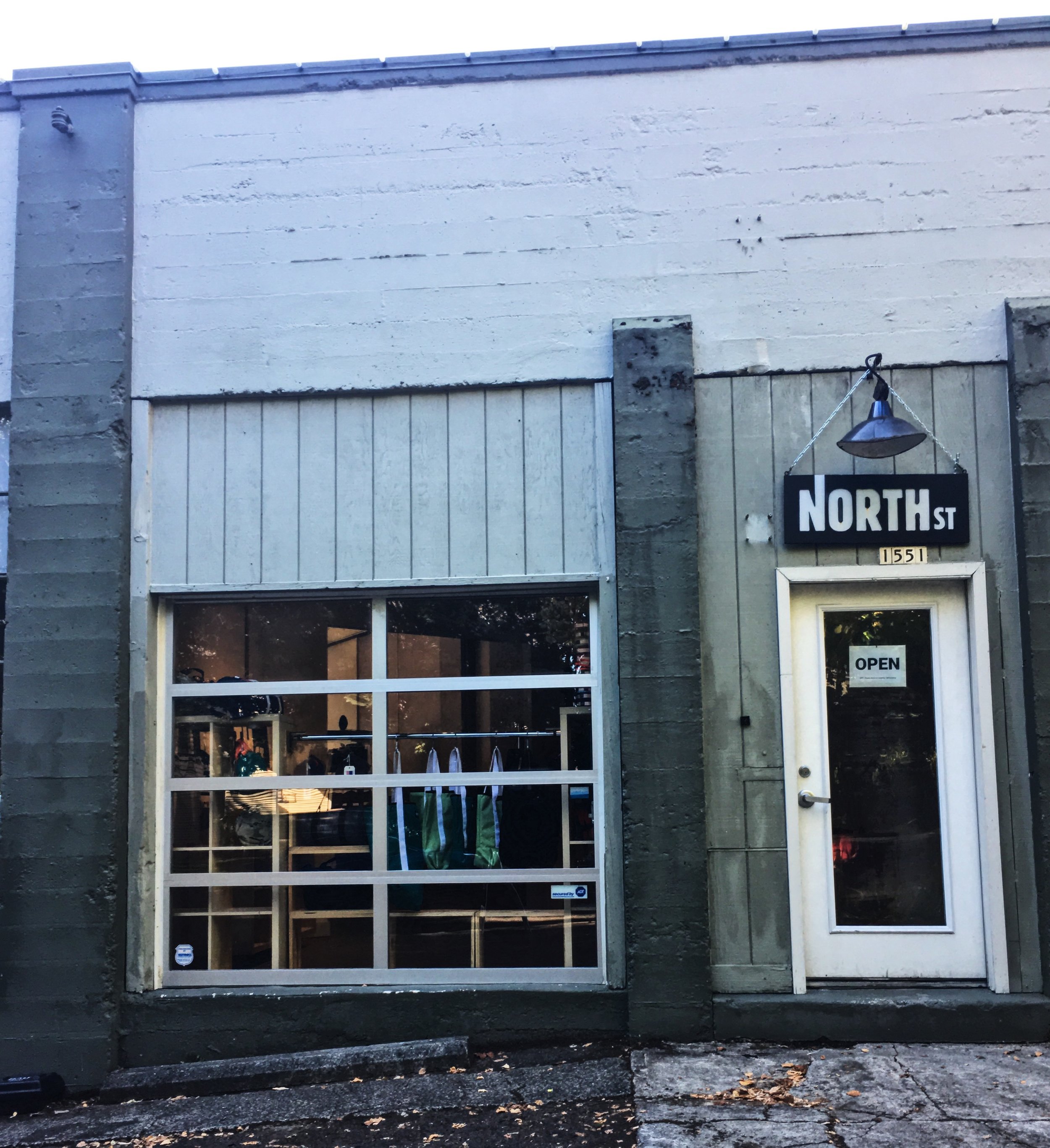
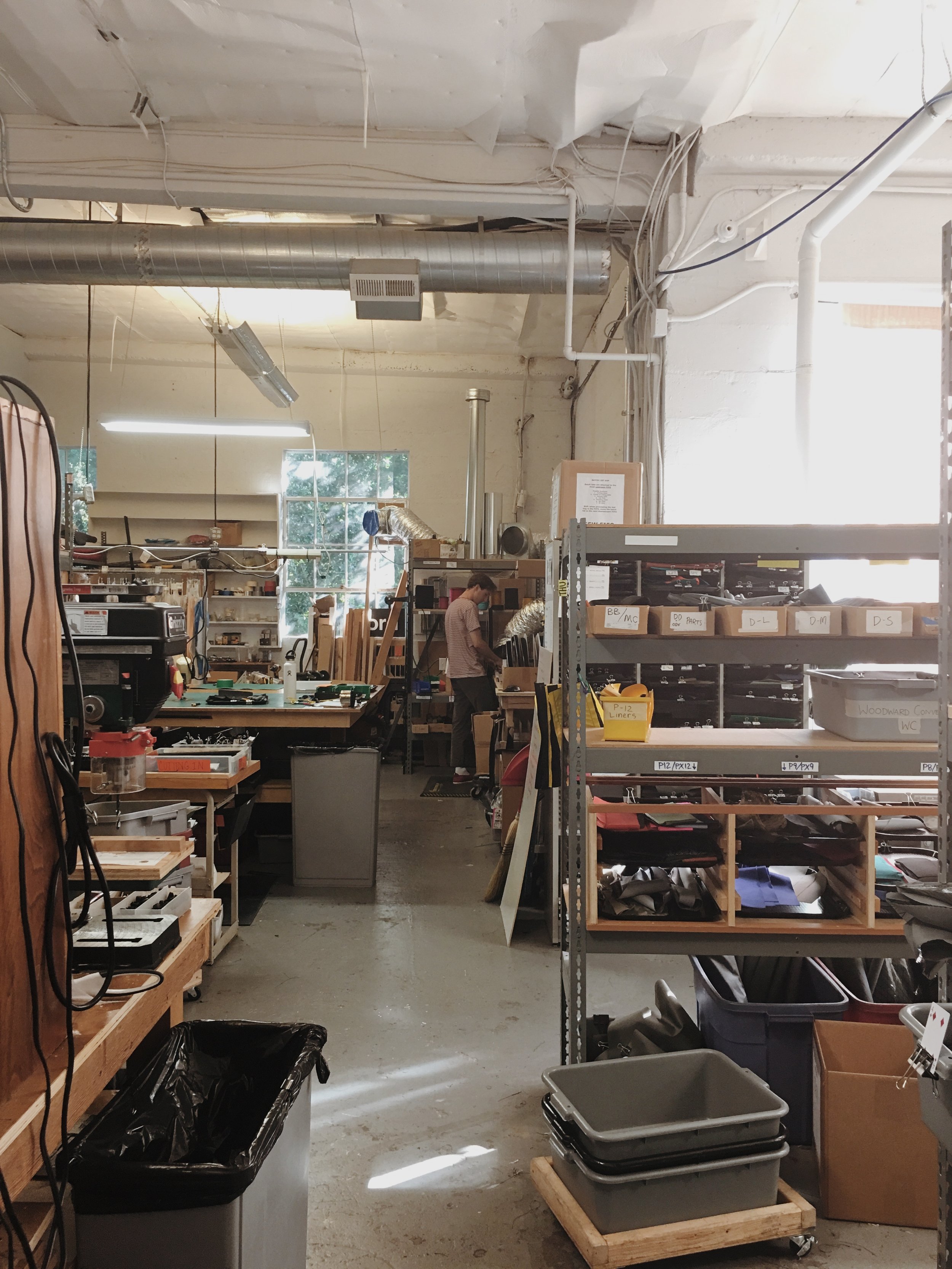
North St. Bags are made a quick bike ride away in Ladd’s Addition near Hawthorne Boulevard. Owner Curtis Williams started the company from his basement in 2009 with one industrial sewing machine and the desire to make a super functional pannier that could be converted into a backpack. Without any significant sewing experience, it took a while to get the design right, but since then Curtis has grown the company and the product line to include a range of panniers, bags, backpacks, and more.

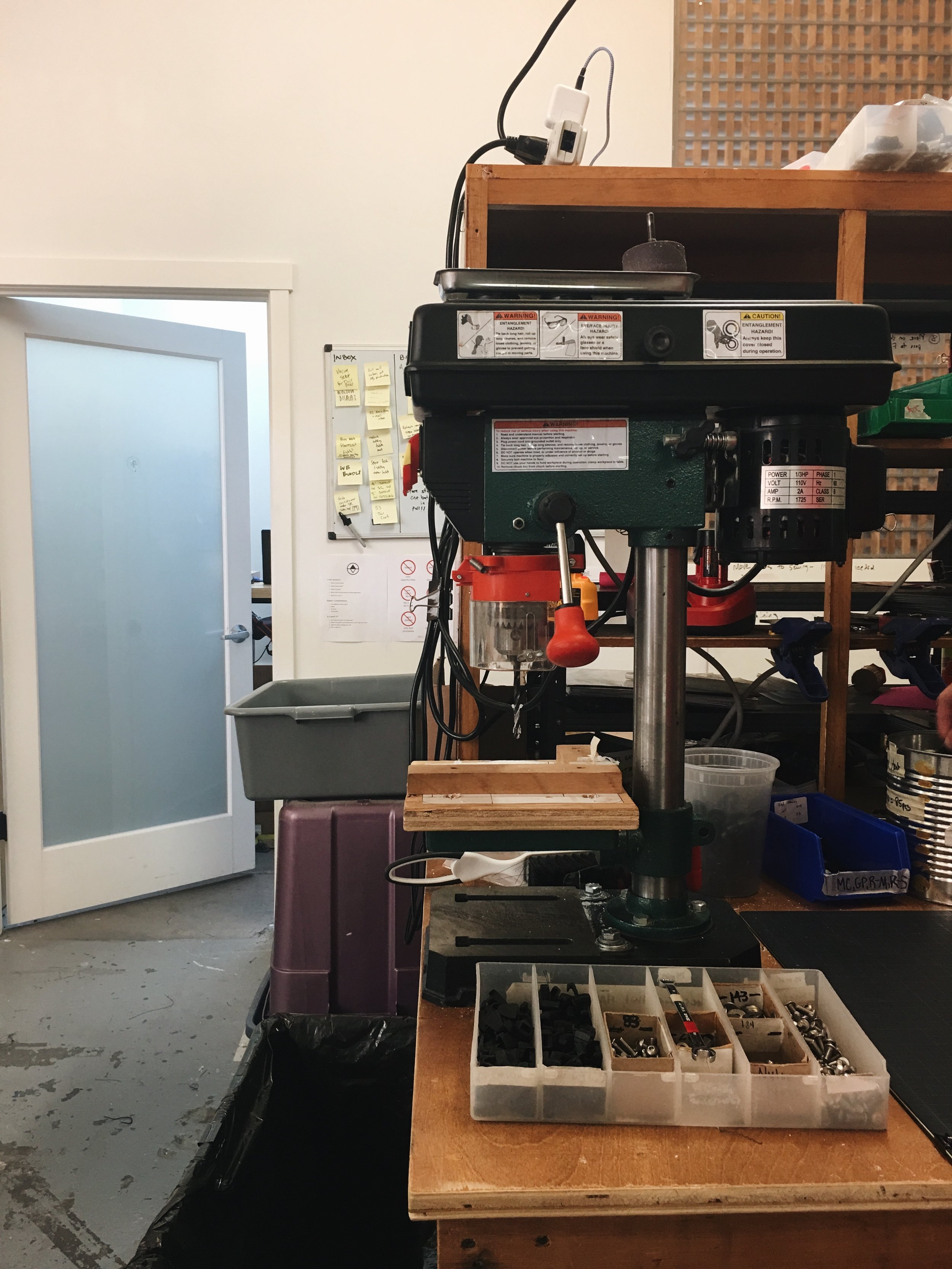
A tour of the North St. Bags show room and work space.

While the company has grown, the commitment to making bags in house from predominantly materials made in the USA has stayed the same. Bags from North St. are also made to order, and customers get to pick their color schemes and other details whether they’re ordering a fanny pack or a pannier. North St. bags also carry a lifetime guarantee, and the nice folks there can handle all kinds of repairs.

During Co-op Month, one lucky Member-Owner will find a golden ticket in with their other incentive that is good for their choice of either a pair of Gladstone Grocery Panniers or two Tabor Totes with a matching Pittock Pouch.

northst_spring_shoot_samples_3 (1).jpg

The Tabor Totes in the large and regular sizes make the best diaper bag, gym companion, or grocery shopping tote. They are super durable, made from 1000 Denier CORDURA® nylon. The matching large Pittock Pouch help to keep your bag organized and small items from getting lost in the bottom of your bag.

grocery-onbike2.png

The Gladstone Grocery Panniers are perfect for running errands, picnic rides, and trips to the farmers market. Made with 1000 Denier CORDURA® nylon, these panniers can stand up to the Portland rain and look great doing it.

Come by the Co-op to become a Member-Owner or invest in your share, and with any luck win some of these terrific bags!

Invest & Win: A Finex Cast Iron Pan!

This Co-op Month, we are thrilled to be offering a few special prizes for folks that become a Member-Owner or make an investment in their share throughout the month of October. There are already some great incentives for investing this month (you can read more about them here), but in with the chocolate bars, reusable produce bags, and other prizes will be three golden tickets: one for bags from North St. Bags, another for a People’s tote bag stuffed full of our favorite fall essentials, and a cast iron pan from Finex!

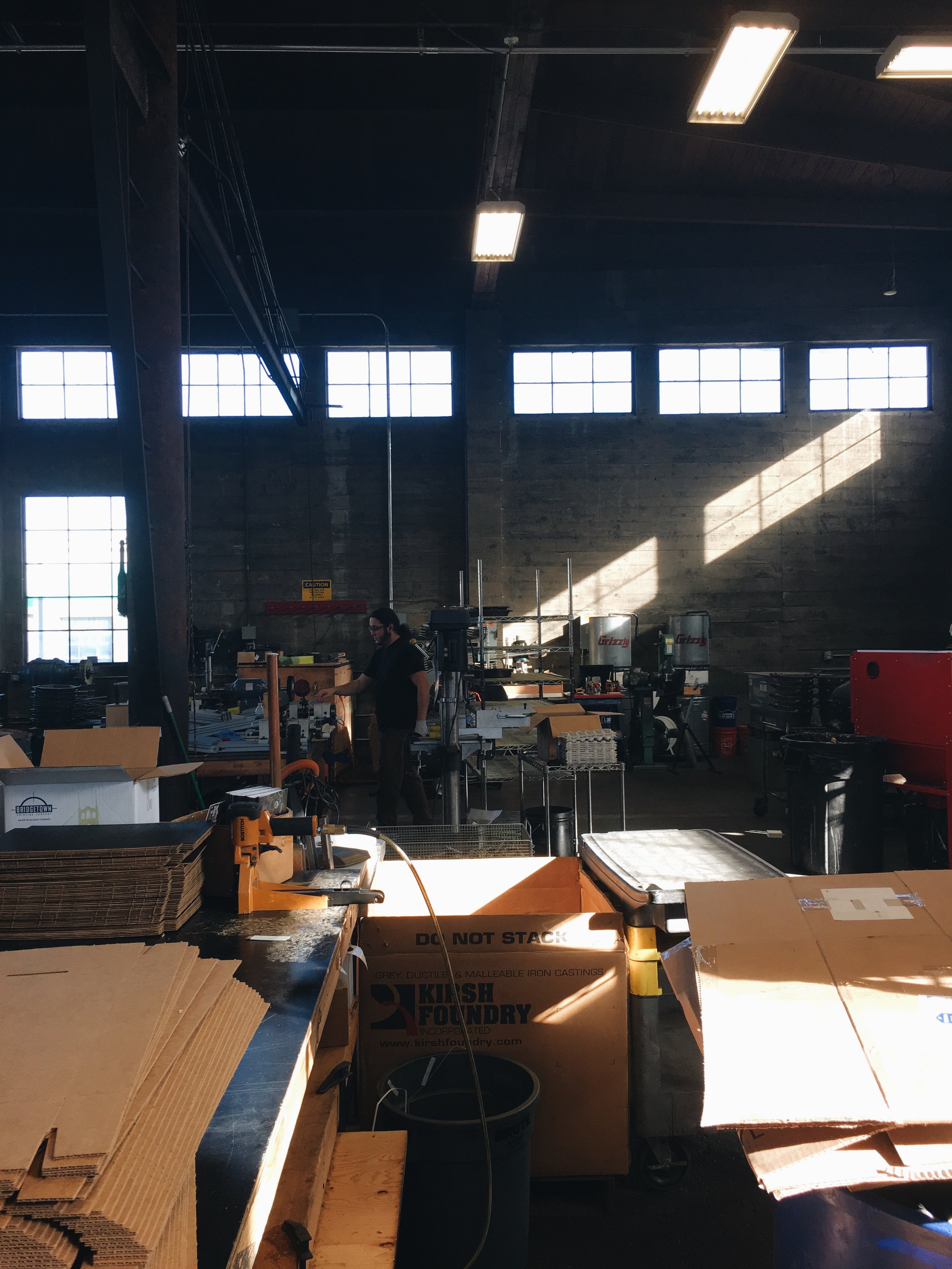
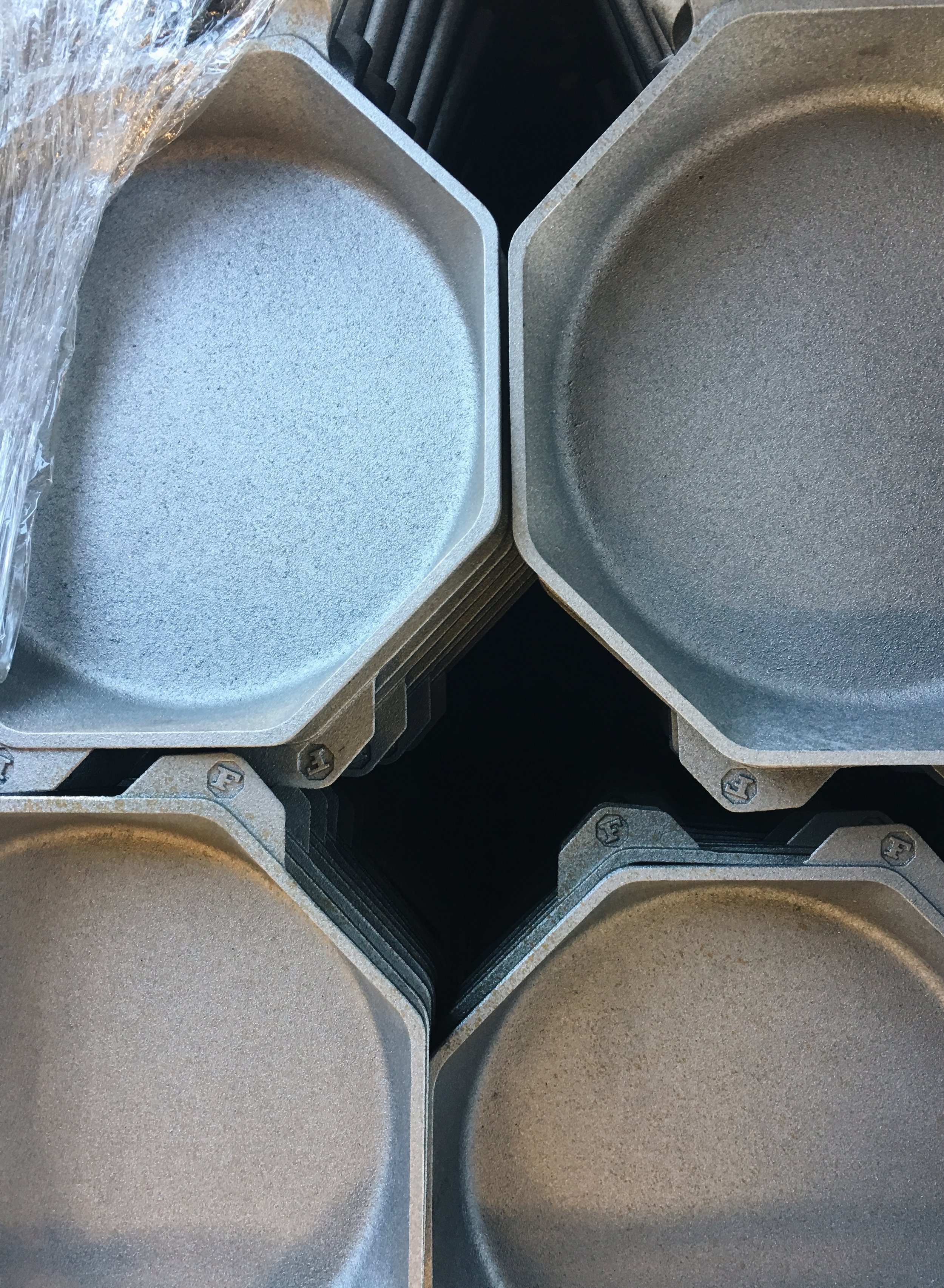
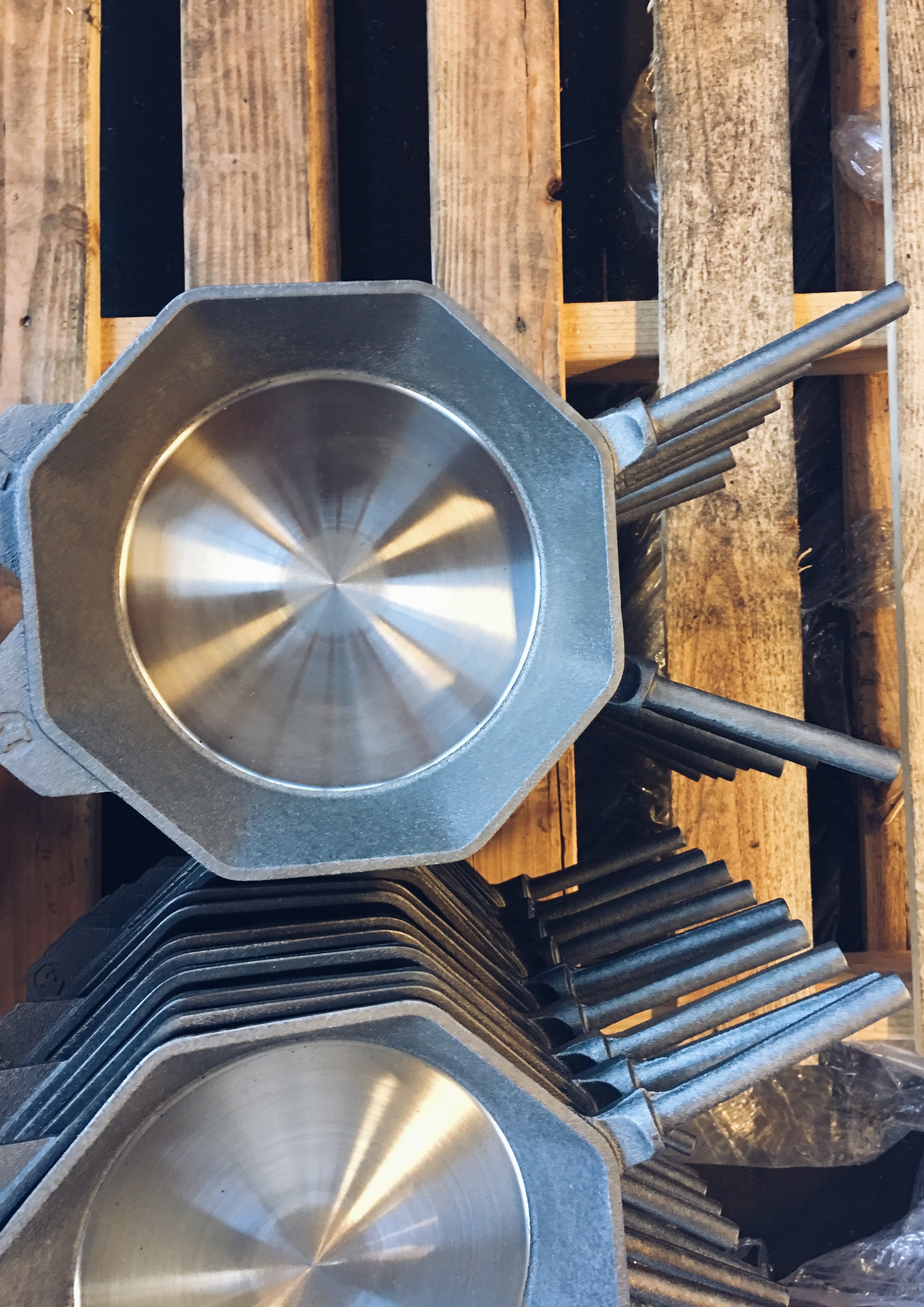
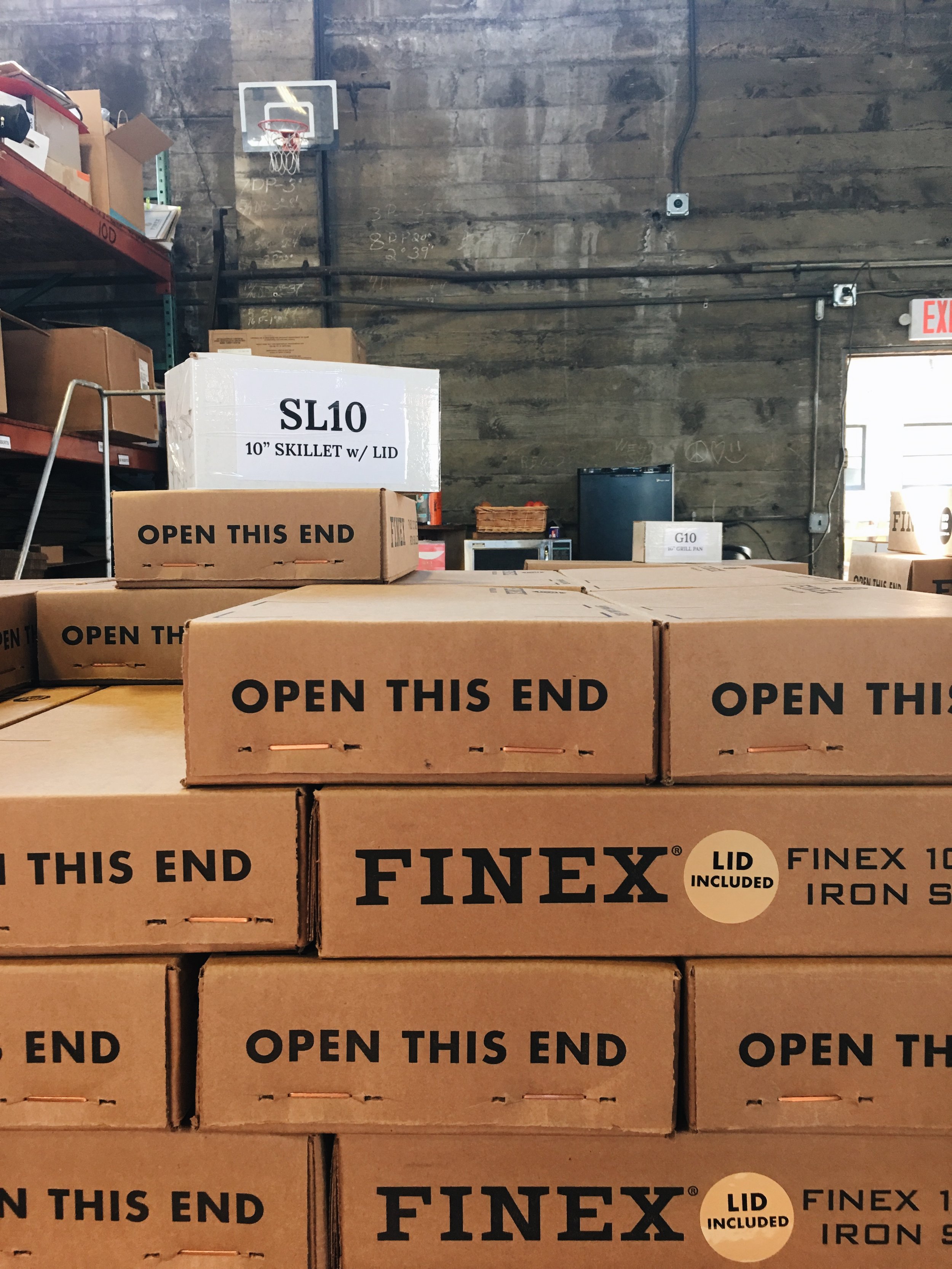
Finex was founded by Mike Whitehead in 2012 after his wife started throwing out all of their nonstick cookware. He couldn’t find a suitable, healthier replacement on the market, but became obsessed with vintage cast iron skillets from the 1940s and ‘50s and decided to start making the pan that he had been looking for. Finex set out to recreate the classic 12-inch skillet and tried a lot of different designs, ultimately settling on a unique octagonal shape and coiled handle. The octagonal shape a big advantage: it eliminates the need for a pour spout on the side of the pan. You can easily pour from any of its eight corners, while a lid will still fit tight without releasing steam or heat to help your cooking. The squarer sides can also make flipping food over easier if you use the corners for leverage. The coiled stainless steel handle doesn’t get hot and cools faster, making the pan easier to handle.

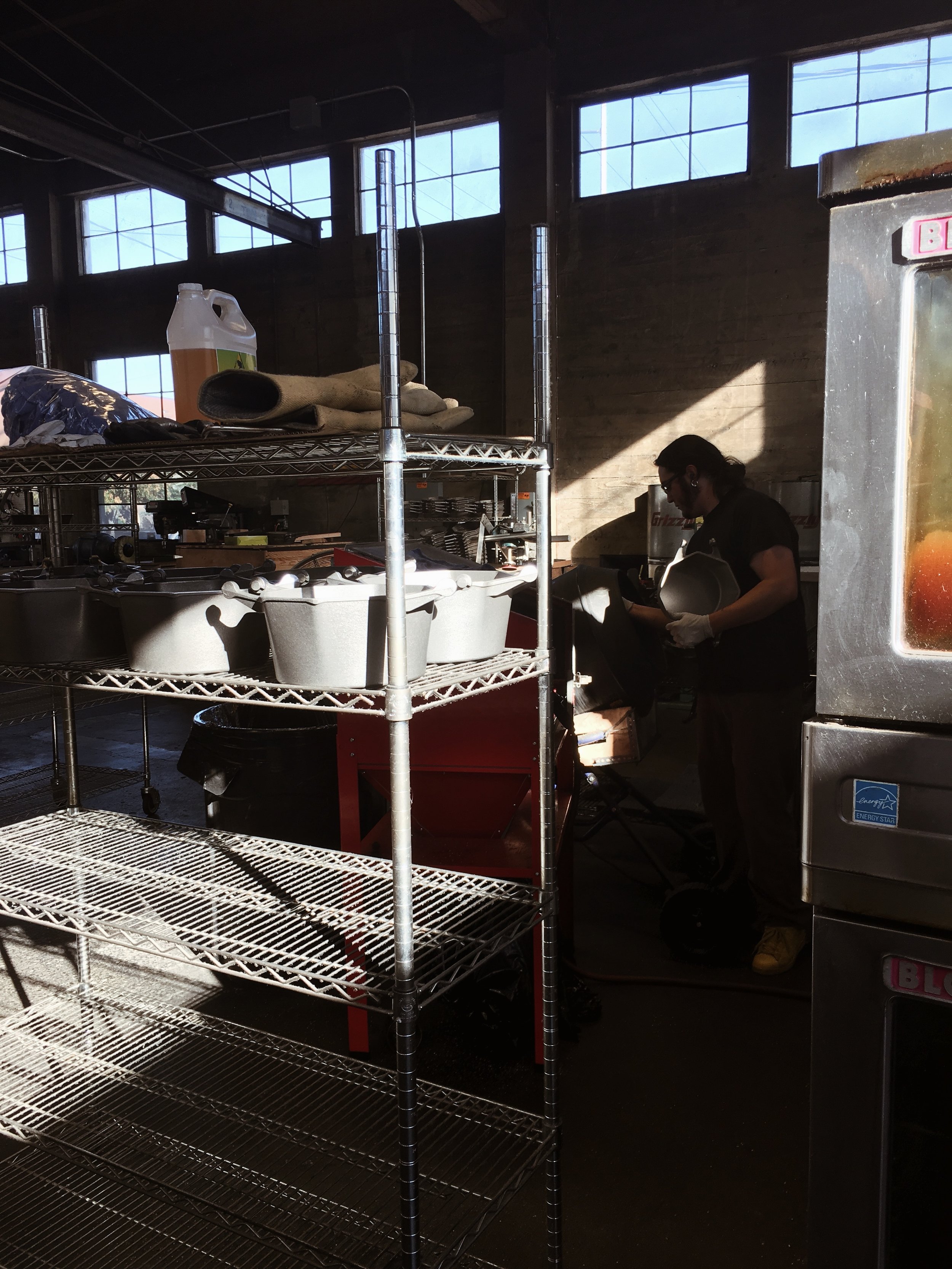
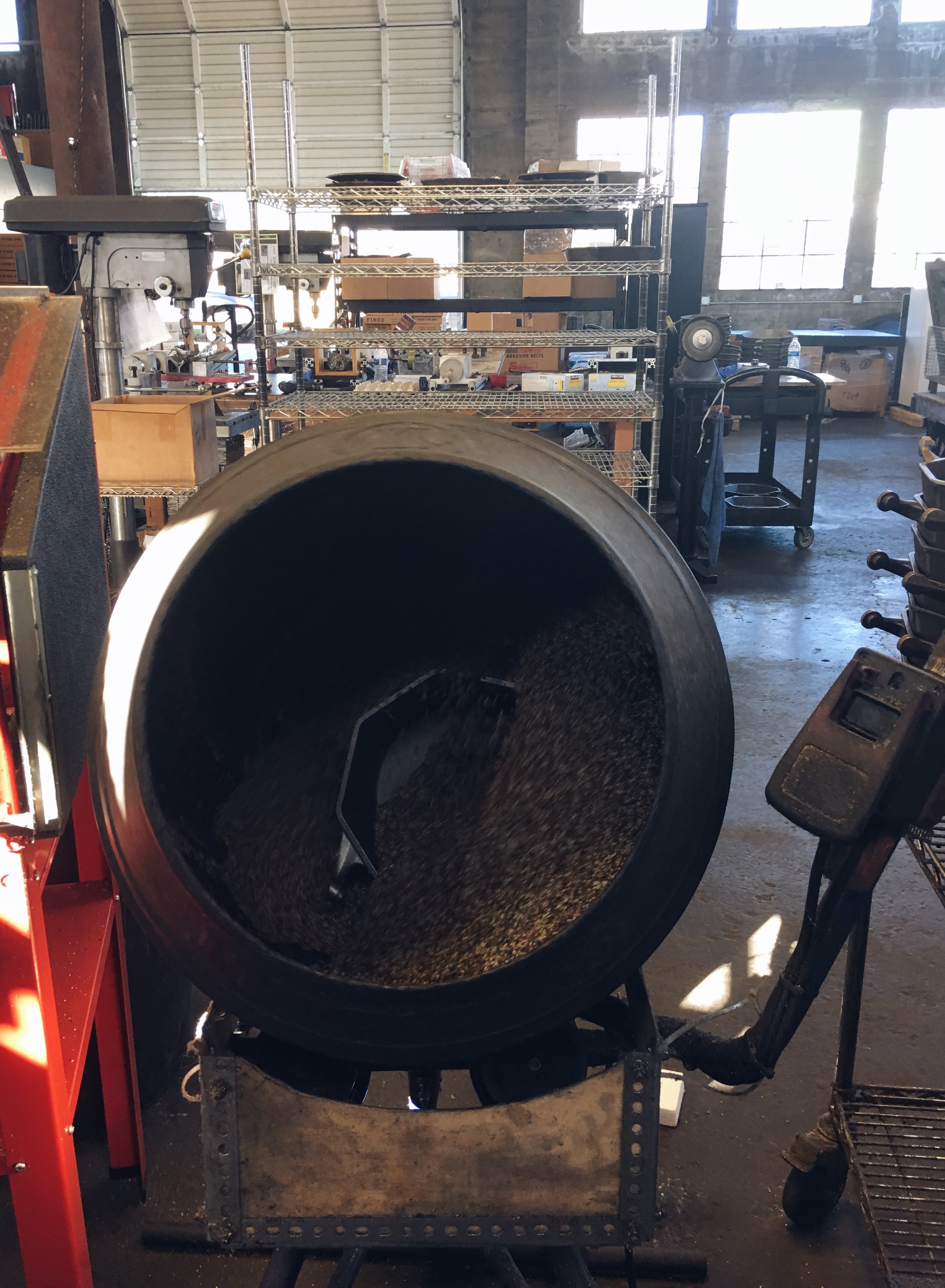
The finishing and seasoning of the Finex pans also makes them something special. They are crafted in a way that gives them the same nonstick sheen of old cast iron pans, and lightly seasoned with organic flaxseed oil for a perfect cooking surface and an almost golden sheen. The pans are all polished by ceramic stones (check out the video on your right), and then tossed in oil-coated birdseed for the perfect application.

Finex pans are made in the USA of pure iron, just like the vintage cast iron that Mike was originally ogling. Each pan passes through the factory here in Portland to be polished and assembled, with most of the components coming from within 25 miles of the Portland factory. Each 12-inch pan has four parts that have to be assembled by hand.

A tour of the Finex factory in NW Portland.

Another great thing about this special cast iron is that you can really beat it up and still return it to fantastic working condition. Scorch it, scratch it, or even leave it to rust, but with some good oil and a little elbow grease you can fix it back up and have it ready for cooking again in no time. Finex pans also come with a lifetime guarantee, and are made to be passed down from generation to generation. The helpful folks there will help you with any pan challenges that you come across.

Come by the Co-op to become a Member-Owner or invest in your share, and with any luck win a lifetime of cooking with this awesome cast iron!

Skillet Baked Savory Cornbread

AA6CA4F9-0AEC-4E8E-819A-0F834B73FE8F.JPG

I enjoy cooking in cast iron on the stove top, but I also love baking in a skillet. This cornbread recipe makes use of delicious local fresh corn that we currently have in the produce department, as well as the terrific cornmeal and polenta from the bulk section. I love this cornbread with the savory flavors of jalapeño and onion, but leave them out if you would rather slather your cornbread with honey or jam.

  • ½ cup of polenta or grits

  • 1 cup buttermilk, or vegan milk or regular milk with a teaspoon of lemon juice added

  • 1 cup cornmeal

  • ½ cup all-purpose flour or gluten-free flour blend

  • 2 teaspoons baking powder

  • 1 teaspoon baking soda

  • 1 teaspoon salt

  • ½ cup or 2 ounces grated cheddar cheese (optional)

  • 2 eggs, lightly beaten, or 2 flax eggs (recipe follows)

  • 2 tablespoons brown sugar or maple syrup

  • 1 cobs worth of sweet corn kernels or ½ cup frozen corn kernels, thawed (optional)

  • ¼ cup thinly sliced chives or green onions (optional)

  • 5 to 6 tablespoons butter, or substitute olive oil or other vegan option

For the topping:

  • ½-1 jalapeño thinly sliced (red or green is great!)

  • ¼ of a red onion, sliced as thin as you can!

  • ¼ cup cheddar cheese

Heat your oven to 400°. In a medium bowl or 2-cup measuring cup, stir the polenta and buttermilk together. In a separate, large bowl, whisk the cornmeal, flour, baking powder, baking soda, and salt together. If you are adding the cheese, stir it into the dried ingredients. Stir the eggs into the buttermilk and polenta mixture, along with with the sugar, corn, and/or chives.

Meanwhile, melt your butter in your 12-inch skillet in the oven. Once it is melted, add all but 2 tablespoons to the polenta-buttermilk mixture. If you are using olive oil, add 3-4 tablespoons of room temperature oil to the polenta-buttermilk mixture, and heat 2 tablespoons of olive oil in the skillet.

Add the wet ingredients to the dry ingredients and mix carefully until the dry ingredients are just moistened – don’t overmix it!

When the butter or oil in the skillet is hot, pour the butter into the skillet. It should sizzle a bit! Sprinkle the top with jalapeño, onion, and cheddar cheese. If you want a spicier cornbread, add the whole jalapeño or mix some into the batter with the wet ingredients. Bake for 15 minutes, or until a toothpick comes clean out of the middle and the cornbread is firm. Slice the cornbread and eat up!

For Two Flax Eggs:

  • 2 tablespoons ground flaxseed meal

  • ¼ cup plus 1 tablespoon water

Stir the water and flax meal together in a small bowl. Let rest for five minutes, and then use in this recipe!


Invest & Win: People's Fall Essentials!

This Co-op Month, we are thrilled to be offering a few special prizes for folks that become a Member-Owner or make an investment in their share throughout the month of October. There are already some great incentives for investing this month (you can read more about them here), but in with the chocolate bars, reusable produce bags, and other prizes will be three golden tickets: one for a skillet from Finex, another for a pair of bags from North St. Bags, and another for a People’s tote bag stuffed full of our favorite fall essentials.

Here’s what’s in that bag:

Montinore Estate 2016 Pinot Noir

(For winners 21 and over!) Montinore Estate makes fantastic wine from grapes grown biodynamically in the Willamette Valley.  This Pinot Noir pairs perfectly with the rich soups, stews, and cheese that you might be eating as the days get colder. You can read all about Montinore here.

Triple Berry Granola

This delicious, organic granola from our bulk section is loaded with raisins, cherries, cranberries, and mulberries which make it a very nice way to start the day. Sweetened just with maple syrup, this granola is just sweet enough. The oats are gluten-free, too!

Golden Lotus Herbs Lung & Throat Herbal Lozenges

These cough drops are essential any time I have a cold or are congested. They are super tasty, sweetened with honey, and have just enough of a menthol touch to clear out the sinuses. It wouldn’t be fall without a few of these kicking around the bottom of my backpack.

Camamu Laranja Chamomile Shampoo

This bar shampoo, made by Camamu in Sellwood, smells delicious and has the nice tingle from added citrus. Bar shampoos are great for travel (they aren’t liquid, of course) and are beloved by zero waste folks for being plastic free!

Rose Black Tea from Two Hills Tea

This keemun black tea is highly scented with fresh organic rose petals. It has a wonderful rosy fragrance and a subtle and rich taste. It is good both hot and iced and should not be missed!

Rooibos Chai Tea from PlantSpeak Herbals

A lot of my time in the fall is spent drinking tea. I always crave the warming spices of chai when the weather gets colder, and this rooibos chai is caffeine free so I can drink it all day without getting the jitters! It’s also delicious.

Winter Squash!

It wouldn’t be fall without a few winter squash-filled meals, and these local, organic squashes are super delicious. We’re including a couple of varieties that are particularly delicious roasted, but also make awesome soups, salads, and pies.

Sprouted & Salted Pecans

Pecans are usually delicious, but these are something else. They are extra crunchy and salted just right. The pecans make an awesome snack by the handful but are also delicious on salads (or anywhere else you can imagine them).

Ayres Creek Loganberry Preserves

Ayres Creek is a very special farm located in Gaston, Oregon. All of the crops that they grow are incredible but they are particularly well known for their fruit crops. Ayres Creek partners with local Sweet Creek Foods to turn their delicious fruit into very delicious preserces. I love a dollop in my morning oatmeal this time of year, and of course its terrific slathered on toast. You can read more about Ayres Creeks preserves here, from farmer Anthony Boutard himself.

Plus:

  • Weleda Sea Buckthorn Hydrating Hand Cream

  • Fire Brew Citrus

  • Casper Candle Company Candle

  • Source Naturals Vitamin D-3

  • Thai Home Red Curry Paste

  • Jem Cashew Cardamom Sprouted Almond Butter

  • Theo Chocolate Bars

The bag is also super cool! It’s sewn and printed by women's cooperatives in India by Re-wrap with an awesome design from local artist Lettie Jane Rennekamp. It’s sturdy enough to carry all of your groceries and even has a pocket! Learn more in our Spring 2018 Grassroots.

Come by the Co-op to become a Member-Owner or invest in your share, and with any luck win an extra terrific prize!


Elections Results Are In!

The winners of our 2018 Board of Directors Election are Liz Robertson, Vishal Dhandia, and Chris Eykamp (pictured from left to right). Welcome to the Board! You are welcome to come see them in action at the monthly Board meetings on the 4th Tuesday of every month from 6-8:30 pm, with a free vegetarian meal at 5:30 pm. Board meetings are held at the Co-op in the Community Room.

Green-Aceres-logo.png

Our community voted for Green Acres Farm Sanctuary to win the People's Cooperative Community Fund prize of $1000! The mission of Green Acres Farm Sanctuary is the prevention of cruelty to, and the commercialization of animals, especially farmed animals. They provide shelter, care and board to abused, abandoned, and unwanted farm animals. They look to inspire change through creating a place where members of the public can have positive interaction with farm animals by providing for their care and the animals can, in turn, educate them about the abusive use of farmed animals.

Thanks for casting your ballot, and participating in the democratic governance of the Co-op!

Looking Into Lents

As we’ve been considering how People’s can grow into the future, it’s become clear to us that the opportunities that come our way are going to, in large part, determine the outcome of this planning process. We can work and think and research and plot all we want, but there’s little use in making a plan if it can’t adapt to unexpected opportunities and challenges that present themselves.

In the Annual Report, which was published in the middle of June, we stated that we were looking to open a warehouse by the end of 2019 and to open a second store by 2023. Those were our best guesses at the time, based on the research that we had done so far and a philosophy of incremental growth. Since writing that update, we’ve dug deeper into opportunities that we first heard about in mid-May, and the cadence and timeline that we outlined in the Annual Report has changed a bit! We are still researching both a second store and a warehouse, but now we’re looking into switching the order: opening a second store in the next year or two and opening a warehouse once we get our footing at the new location.

This switcheroo is all because of a particular opportunity. As you may be aware, we’ve been interested in opening a second store in the Lents neighborhood for some time now. If you’ve been around for a long time, you might remember that the Co-op was actually considering a second store in Lents during a development process ten years ago. So when a developer that’s working on a number of projects in Lents reached out to us about a possible site for a store there, we were eager to learn more.

As we’ve learned more about the development opportunity in Lents, we think that it could be a terrific next step for People’s for these reasons:

  • The space has the potential to be built out to about 6,000 square feet, which is our ideal size for a second store.

  • It’s right next to the Lents International Farmers’ Market, Green Lents’ Community Tool Library, and Zoiglhaus Brewery, all organizations that create important resources in the Lents community.

  • It’s really close to the Boys & Girls Club, the Asian Health Center, Zenger Farm, and lots of homes, including new mixed-income apartment buildings.

  • There is great transit access: the MAX Green Line, 10 & 14 buses, 205 bike bath, and Interstate 205.

  • The company developing the site is interested in installing solar power and other green technology.

  • Lots of folks from Lents have reached out to us to ask us to open a store there, and a grocery store has been a priority for the residents for a while.

  • There are plans for a permanent farmers’ market pavilion on site.

  • There are a number of Member-Owners that live closer to Lents than our current store. If they shop there instead, it might relieve some pressure on our current store.

We also know that there are a lot of questions that we will have to seek answers to:

  • Just like here, there isn’t currently a loading dock. Deliveries could be complicated, especially big ones, unless we can find a solution in renovating the building.

  • Lents is a really different neighborhood than where we are now! How can we be a store that is relevant to the community there? Will we need to sell different kinds of food?

  • How can we avoid contributing to the gentrification happening in Lents, or be a resource to folks that are at risk of being displaced?

  • How many people will shop in Lents instead of here? Can we sustain our sales, or find a way to make up for the loss?

  • Opening a second store is a huge undertaking, and it will take a lot of dedication from our staff and current Member-Owners to make it happen. Do we have the support that we need to create another People’s on this timeline?

Over the next few months, we’ll be doing more work to find out if this is a project that we want to move forward with. That work will include talking to lots of folks in Lents about what they want from a grocer, as well as getting feedback from our current Member-Owners about their thoughts on this opportunity. We’ll also need to do more specific financial feasibility research, and conduct another market study based on this particular site. As we learn and process more information, we’ll share it with Member-Owners through the blog, Grassroots, and in-person events.

Like everything we do at the Co-op, we know that whatever development projects we decide on will have to be a community effort. We’ll depend on our Member-Owners and other folks in our community to help us make this happen, from installing store fixtures to helping us fund the project. At this stage in the process, here are ways that you can help us move forward:

  • What do you think about this project and the idea of a second store in Lents? Let us know!

  • Do you live in or near Lents? Who should we talk to about opening a store there?

  • Do you know about resources that might be helpful? What about skills you might be lend to the cause? Let us know about them!

  • Be on the lookout for more opportunities to get involved.

As we hone in on the specific projects that will shape the Co-op’s future, we as a committee are feeling a variety of feelings! We’re excited about many of the details of this particular opportunity and it feels really good to be talking in concrete terms. After talking about the future of People’s so abstractly for so long, it’s energizing to visualize the possibilities at a particular site.

We also feel some nervousness about the whole thing: concentrating our resources on one opportunity and moving a bit faster than we were anticipating a mere month ago both create some anxiety. We anticipate that Member-Owners might feel a similar mix of emotions! That being said, we are very enthusiastic about the opportunities that this site in Lents offers, and are eager to explore the relationships that we can build there, both with individuals and like-minded organizations. We’re looking forward to the next few months of research, and continuing to engage our Member-Owner community as we learn more and move toward making a final decision about this project.

If you have questions, concerns, or input, please be in touch with the Board of Directors! You can email them at bod@peoples.coop. You can also get in touch with the Long-term Planning Committee at planning@peoples.coop.
 

July Long-term Planning News

The Collective Management has been working on creating a plan for the Co-op’s future for a number of years now. Our strategy has been to gradually narrow our options over time until we settle on a combination of projects that can meet our needs and that we feel secure moving forward with. This process hasn’t been totally linear, but we are getting closer to making a final decision in the fall. The Collective narrowed our options in February - hopefully you read about it in Grassroots - and we did so again at the end of June with the full support of the Board of Directors. We decided:

  • To open a small second location by the end of 2023, and continue to pursue retail opportunities or other innovative ventures thereafter.

  • To not expand our current store. Instead, a committee of the Collective Management will form to conduct smaller-scale improvements on-site.

  • To continue to look into ways to collaborate with other local co-ops and rad food businesses, but not formally merging with any other local co-ops at this time.

  • To improve efficiency of systems and structures at the current store with the primary focuses of reducing labor and sustaining or slightly increasing sales.

  • To acquire and incorporate a warehouse into our operations.

  • To establish some kind of prepared foods venture (deli, juice bar, café, grab n go, etc.)

We shared that we were bringing these items to the Collective and the Board in the summer Grassroots, but a decision hadn't been made when we went to print. We wanted to be sure to share with Member-Owners that the Collective and the Board agreed that these are the ways to move forward, with minor changes to what we shared in Grassroots. 

This decision is exciting: these are the projects and elements that will guide the Co-op into the future and secure our footing for many years to come. We’re looking forward to seeing how they take shape, and where they take us.

The Collective also made these decisions with full support of the Board of Directors, which passed a resolution at their June meeting in support of the six decisions above. You’ll be able to read their statement in the Board meeting minutes by the end of July, on the bottom of this page

In the meantime, if you have any questions or feedback about these decisions, feel free to get in touch with the Board of Directors at bod@peoples.coop or email the Long-term Planning Committee at planning@peoples.coop.

Take Our Survey!

Your voice really matters here. 

Every few years, we ask our Member-Owners and shoppers to tell us how we're doing. We take these surveys super seriously and they really help our staff to figure out what's going well and where we need to do better. Especially as we approach decisions about our long-term plan, your voice is critical in shaping our grocery store and our community. Plus, you'll get a free bar of Equal Exchange chocolate for weighing in and might even win a $100 gift card! 

Lil' Starts: Our Latest Farmer Loan Recipient!

By Serina Hamilton, Operations Manager & Co-manager

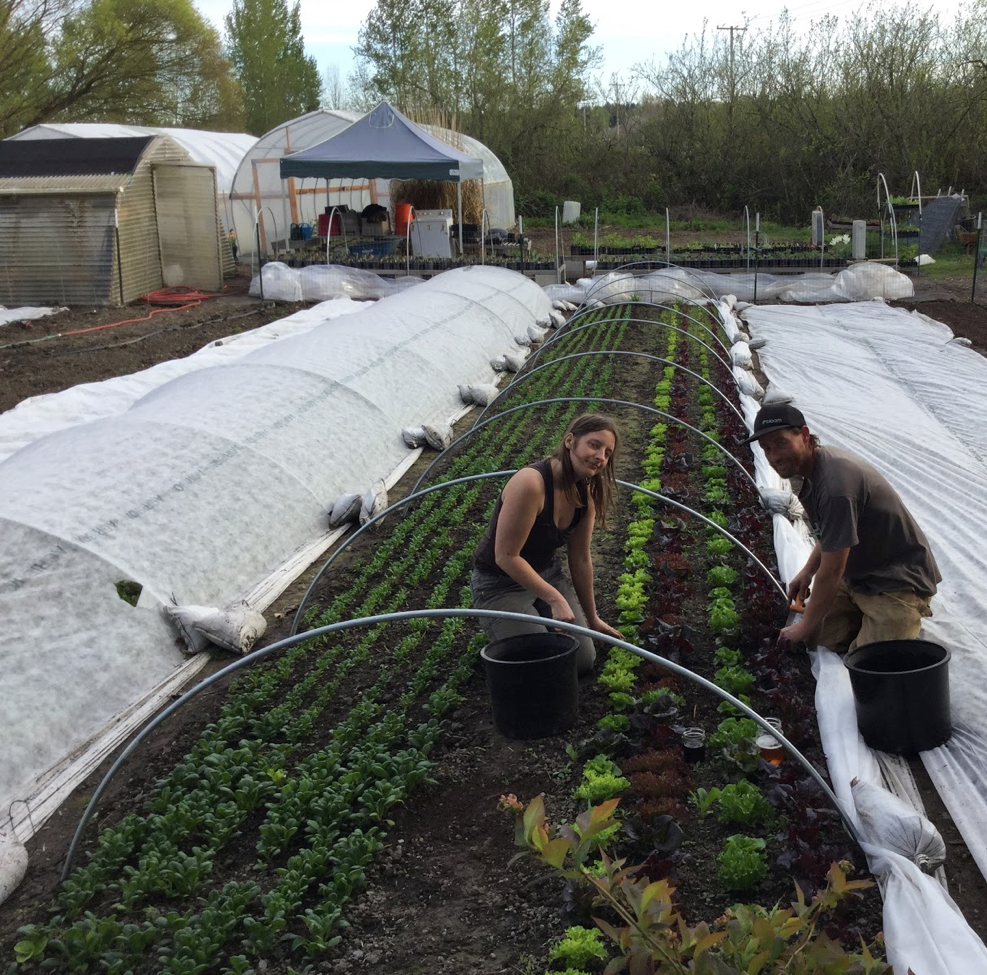
I’m delighted to announce that People’s Food Co-op was able to give Lil’ Starts, a local urban farm in NE Portland, a $1000 loan through our interest-free farmer loan program! This is something we offer to those who may need a little help getting started launching their new farm or new project. We reached out to Lil’ Starts and asked the two owners (Lilly and Luke) about their gorgeous lil’2-acre farm so we all can get to know them better. Here is the conversation I had with Lilly about their practices on the farm and where they are offering their starts and produce this season.

Lil Starts Logo.png

I read on your site that you are passionate about natural and sustainable growing methods, as well as how Lil' Starts uses permaculture and biodynamic principles. Can you tell me a little more about that? What sort of methods do you use for natural and sustainable growing? What sorts of principles go into permaculture and biodynamic growing for Lil' Starts?

At Lil’ Starts we wholeheartedly believe in growing clean, healthy, sustainable produce and plants for our community. Our farm is 100% free of GMO’s, pesticides and synthetic fertilizers. We feed with compost teas made with compost and worm castings from the farm and fish fertilizer we ferment from salmon scraps given to us from local fishermen friends. We buy amendments from local farm stores to supplement our field soil and to use in our potting mix- fish bonemeal, alfalfa meal, sea kelp; the only mined amendments we use are azomite and dolomite lime.

Our compost is a good mix of chicken straw and droppings, plant material and leaves, and kombucha and fruit scraps from our friends at Lion Heart Kombucha – they are located just around the corner from us and the SCOBY culture, ginger and fruit pulps, and green and black tea leftovers definitely keeps our compost piles heated up, decomposing and loaded with probiotics. We’ve always loved the smell of good compost but this stuff makes it absolutely divine, when we turn the pile or add more Lion Heart material the whole farm smells good.

Lil Starts.png

For pest control, prevention is key and that is why we encourage healthy soil by limiting the amount we till (we only use a small BCS tiller when we are breaking ground or have let a bed go fallow otherwise it’s wheel and hand hoes and broad forks), limiting our use of amendments and allowing flowers and seed heads to grow all over to encourage beneficial insects. We also spray our crops weekly with compost tea in the early part of their lives. We also spray with a farm made mix of hot pepper, garlic, rosemary, lavender and sesame oil tea at the first sign of pest infestation. We do keep a bottle of organic plant-based neem oil around in case of emergencies but luckily we hardly ever need to use it. Slugs can be a big problem and we have had to resort to using organic Sluggo in super wet springs.

We have a small flock of chickens and regularly add food grade diatomaceous earth to both their feed and sprinkled in their coop to kill off mites, lice, and internal parasites. Apple cider vinegar gets added to their water once a week for the same reason. Our flock has a rotating pasture and we also feed them high-quality Union Point feed from Brownsville Oregon.

Lil Starts Rows.png

Do you offer a CSA program? If so, what CSA programs do you currently have available for people to sign up for the 2018 season?

We offer two CSA programs. Our Veggie CSA is sold out for 2018 (thank you community!). We have a few spots left for our Gardeners CSA. This is a live plant CSA designed for backyard gardeners that supplies you with ready to plant veggie, flower and herb stars once a month during the growing season.  The Main Season option runs April thru July for $150. The Late Season option will make sure you have a late fall, winter, and early spring harvest and runs August thru October for $65.

Spring has sprung! Which means that farmers' market season is here! Where can we find Lil' Starts this season?

This market season you can find us selling plants at Montavilla and St. John’s Farmers Market in May and June. We will be offering our produce all season long at Woodlawn Farmers Market, Hawthorne Farmers Market, and Kenton Farmers Market.

Synthesis Committee Update

By Jenna Whitaker, Board member

It’s a wrap! After 3 months of digesting and integrating Member-Owner feedback, the Synthesis Committee has completed its task of producing a recommendation for the Co-op’s long-term planning process. This recommendation or “synthesis” reflects the wealth of input received from Member-Owners via feedback sessions, survey responses, and emails.

The Synthesis Committee was an offshoot of the Long-term Planning Committee (LTPC) and comprised of 10 people:

  • 4 Member-Owners, each elected from a different feedback session that took place in September and October 2017: Chris Eykamp, David Todd, Judith Maron-Friend and Phil Quitslund
  • 3 LTPC Members: Ashley Todd, Finnley LoPresti and Sofie Sherman-Burton
  • 2 Board Members: Dave Wadley and myself
  • 1 Collective Manager not on the LTPC: Kahadish Wa’adabisha

Each of our meetings were facilitated by David Osborn, who also created the format we used to explore and organize the information. The work involved a lot of reading and grouping comments and ideas into common themes. It was colorful and challenging at times, but we managed to reach consensus on every aspect of our task. Our finished project is a comprehensive summary of these themes with supporting feedback, and a recommendation for the process moving forward.

While we each brought a variety of our own experience to the Synthesis Committee, it is important to recognize that many of us benefit from white privilege; the summary we made is no doubt impacted by that fact, though it is difficult to say exactly how. As a Board member, I hope that we can work to bring more diverse perspectives into our participatory processes in the future.

The Synthesis Committee recommended that the Co-op rule out the option of relocation and focus on researching options to stay viable and relevant at its current location. We received ample feedback from Member-Owners sharing their personal connection to the building and its ties to the community, along with other concerns about the financial ramifications of moving the store. Some folks shared ideas for helping us sustain in place. The LTPC considered the Synthesis Committee’s input in forming their recommendations for the Collective Management. You can read more about those recommendations and the LTPC’s future research in their update, which follows.

I would like to thank every person that wrote an email, attended a feedback session, or participated in this process in any way thus far. Your thoughts and words are meaningful, impassioned, and clearly reflective of your values and experiences. Hearing your different ideas, concerns and feelings was an incredible opportunity and an interesting way to get to know my position on the board. I look forward to seeing where this process takes us!

Grow Your Own Produce Classes Are Back!

Interested in cultivating your own food? Join us for our annual Grow Your Own Produce Workshop Series! 

By Brita Zeiler, Community Room Coordinator & Co-Manager

Many of us are looking forward to warmer weather, longer days, and the opportunity to get our hands dirty in the garden. New gardeners may be looking for resources to learn how to plan and create a vibrant garden. While experienced gardeners seek to get expertise and questions answered. All are welcome to the Grow Your Own Produce Workshop Series where they will learn to develop their own Permaculture Gardens!

Educator and Designer, Marisha Auerbach answered a few of my questions about her unique workshop series:

What will new gardeners & experienced gardeners walk away with from your Permaculture Series?

Each month, we discuss the key things to do in the garden to help keep us on track with the seasons.  New gardeners will find the information on when to plant and how to tend to your plants each month as a valuable guideline to help them learn how to have a good harvest.  By gathering together each month, I provide "bite sized" information to help new gardeners avoid being overwhelmed by the vast amount of possibilities in the garden.  Experienced gardeners seem to always find something new that they learned in each class.  This is why some people choose to take the series more than once!  Experienced gardeners enrich the discussion by asking more advanced questions and providing insight based on their experience.  This helps our class understanding deepen into the differences that we may experience by having different microclimates in our yards and living in different microclimates of our region. 

We have enough time for everyone to get their questions answered.  This allows for customized information to support participants in their gardening endeavors.  

There are so many things to consider in the garden that there is always something new to learn.  From reading the landscape, proper harvest techniques, varieties bred for our region, pests & diseases, and how to develop a resilient garden in an unpredictable climate, we cover many different topics in the garden throughout the workshop series.  

DSCN9195.jpg

What are some of the highlights and not-to-miss moments of your series?

The first class helps students with site analysis.  We go over how assess the offsite influences (sectors) and microclimates on your site.  Offsite influences and microclimates can help us identify how to develop a garden layout that matches our unique considerations of our site.  We also talk about how to design a garden based on your relationship with your landscape.  These considerations help us enhance our localized conditions to put the right plant in the right place.  

I consider each class to have highlights, depending on what each participant wants to learn most.   

Each month, we cover the top vegetables for the month and there is a theme for each month.  I love talking about how to build soil, edible flowers, saving seeds, and food preservation.  Many people find the section on pests and diseases to be very useful.   

The classes in July and August are outdoors.  We have a field trip to look at and taste various berries that one could grow in their garden.  In August, the class is at my house and we cover Seedsaving and the Winter Garden.  This class actively teaches each student how to save seeds with hands-on activities.  September's class also has a hands-on component.  In September, we talk about Putting up the Harvest and actively do some fermentation and dehydration during the class. 

Why are you passionate about growing food?

My connection with my landscape helps me inhabit my home.  Dancing with life in this way is our birthright.  It is a beautiful way to practice coming home to planet earth, Cascadia bioregion, Woodstock neighborhood.   By having a diverse landscape outside my door, I feel in touch with the seasons.  I recognize the birds that visit at various times of the year and I get to know what they like to eat and where they like to be.  I love the seasonal harvest cycle.  I find that I look forward to the new crops as the wheel of the year turns.  Gardening is an activist practice.  By stewarding my soil and eating local food, I know that I am reducing my impact on other lands.  Food is one thing that all people need to live.  By developing a practice of gardening, it enhances my resiliency and helps me have information and surplus to share with my community.  I grow many diverse types of vegetables and fruit and I also grow my own medicine.  My surplus medicinal products are available to my community when they need some support from our herbal allies.  I know that my home garden is doing it's part to protect pollinators, both the European honeybee and the native bees through diverse flowers and seasonal blooms.  

Sign Up

Planning, Design & Framework

Tuesday, February 13th 7-9pm
This opening session will focus on garden planning and design. From the Macro perspective to the microclimate, we will discuss Permaculture design strategies that can maximize your yields and diversity of crops throughout the season. Fruit trees, berry bushes, and other large landscaping elements will be discussed as the framework for creating the context for your space. Each participant is encouraged to come with a base map of their site. Please contact Marisha if you need support before class to have this available.

DSCN9192.jpg

Indoor Seed-Starting, Early Plantings & Perennial Crops

Wednesday, March 20th 7-9pm
In March, it is time to begin planting seeds both outdoors and indoors. This session will focus on those early plantings and the varieties that perform best for our climate. Perennial vegetables can be transplanted at this time. Since many perennial vegetables are new to gardeners, Marisha will share about growing and cooking some of her favorite types. Seed catalogs and other resources will be available as references for each participant to make a personalized planting calendar.


Cole Crops, Greens & Soil Building

Tuesday, April 10th 7-9pm
April is a key time for all of the Cole Crops, such as Broccoli, Kale, Cauliflower, Collards, and Cabbage. It is also a time of planting greens. As many plants are being planted in the garden during this month and the months to come, we will highlight soil building strategies in this class.


Warm-season Crops, Edible Flowers and Attracting Pollinators

Tuesday, May 1nd 7-9pm
In May, the weather typically gets warmer and many flowers begin to bloom. We will discuss reliable varieties of warm-season crops to grow in your garden and ways to maximize microclimate and production. Many of these plants require insects for pollination. You will learn about pollination, pollinator insects, and flowers that are useful for attracting these special critters. Many of these flowers have multifunctions. We will highlight edible flowers, their functions in landscapes, and recipes.


Maintenance and Harvest

Tuesday, June 5th 7-9pm
June completes our planting of the summer vegetable garden and then it is time to focus on maximizing the harvest. For the urban gardener, this may mean optimizing a small space to produce as much food as possible. We will discuss strategies for optimizing yield of your vegetable crops throughout the growing season. We will highlight the best types of trellises for plants that like to grow up.


Berries, Herbs and Water Catchment

Tuesday, July 10th 7-9pm
This workshop will focus on different types of fruiting crops that are available right now. We will taste different varieties and discuss recipes and ways to put up the harvest of berries. We will talk about water catchment and how to determine what type of system would work best for your household. Handouts will include a to do list for the month, herbs for tea, and other pertinent information.


Seedsaving and the Winter Garden

Tuesday, August 7th 7-9pm
In August, it is time to save seeds. The weather has been dry and many plants are ripening their seed. This workshop will cover the basics of saving seed and offer you the opportunity to gather some hands-on experience. August is a key month to get many starts in the ground for harvest in the winter and early spring. This class will highlight what is happening in the garden in August, how to preserve your harvest and prepare for the coming month.


Putting Up the Harvest

Tuesday, September 11th 7-9pm
The abundance from the garden and orchard is coming in and it is time to put it up for storage in the winter. In this class, we will discuss the key ways to store food for the winter including canning, dehydration, fermentation, & freezing. A key component of this class will be focused on how to assess what your family will eat in the winter and the space that you have available for storage. The last of the winter crops should be in the garden by Equinox so we will cover the last of the plantings. As always, this class will highlight what is happening in the garden in September, how to preserve your harvest and prepare for the coming month. Handouts will include a to-do list for the month, information on canning and food preservation, and other pertinent information.


Garlic, Cover Crops & Compost

Tuesday, October 9th 7-9pm
October is a time for returning inward and thinking about nourishing the soil for the future garden. This class will highlight soil building method including mulches, composting, leaf mold and more. We will discuss types of cover crops for building soil tilth and fixing nitrogen. Garlic goes in the ground this month for summer harvest. We will talk about the different types of garlic and best varieties for our region. As always, this class will highlight what is happening in the garden in October, how to tend to your garden, and prepare for the coming month. Handouts will include a to-do list for the month, information on soil building methods, and other pertinent information.


Wildlife in the Garden, Nourishing Soups & Planning for the Coming Year

Tuesday, November 6th 7-9pm
In November, the weather has become cold and the garden has been put to bed. However, the birds, insects, and other critters still need habitat to keep them around. During this class, we will discuss ways to encourage these allies to stick around in your garden. By having active food webs in the garden, we invite collaboration and enhance fertility cycles on site. As this is our final class for 2018, this class will provide juicy information to help you begin planning for the 2019 garden season. We will also highlight nourishing soup recipes from local herbs, veggies, and stocks. As always, this class will highlight what is happening in the garden in November, how to tend to your garden, and prepare for the coming month. Handouts will include a to-do list for the month, information on wildlife, soup recipes, and other pertinent information.



Montinore Vineyards - Deep Roots in Oregon Biodynamic Farming

Montinore Vineyards - Deep Roots in Oregon Biodynamic Farming

By Ryan Gaughan, Alcohol Buyer & Co-Manager

I have always been fascinated by the environment of the Pacific Northwest. Living in the Portland area, we have the ability to travel a few hours in any direction and find ourselves in starkly different places. From lush, green valleys to rugged mountains and desert, the land offers different possibilities for what people can grow and cultivate.

This entire landscape was formed by fire and flood.  

Approximately 15 million years ago, massive chasms in the earth’s surface opened in what is present day Eastern Washington and Oregon, spewing flows of lava across the land. For millions of years, fiery rivers of liquid rock spread out over the land, eventually cooled, and then gradually sank into the surface under their own weight. Eventually these expansive basalt flows became the foundation of the Columbia Basin and its watershed.

The earth was really only getting warmed up. During the last Ice Age, approximately 18,000 to 13,000 years ago, a giant frozen ocean sheet covering much of present day Canada began slowly drifting South. One arm of this ice sheet formed a dam on the Clark Fork River, resulting in the formation of Glacial Lake Missoula, extending into much of present day Montana. This body of water, about the size of Lake Erie and Lake Ontario combined, was held in place by an ice dam 30 miles wide and 2000 ft high.

The dam did not hold. At one moment in history, a wall of water 2000 ft high barreled with catastrophic force all the way to the Pacific Ocean. As it did so, it stripped all of the vegetation, animal life, and topsoil back down to the ancient basalt flows in a giant flush. Floods happened repeatedly, each time pulling up the land and leaving unfathomable amounts of rock in their wake. These layers of rock became the substrates for what today comprises the fertile lands of the Willamette and Columbia Valleys, and Eastern Washington.

Most agricultural activity in Oregon takes place within the basalt tendrils of this great geological odyssey. The Willamette Valley is one of them, stretching 150 miles, from Portland to Eugene. It is here, for reasons that have just as much to do with climate as they do with geology, that specific conditions are correct for the propagation of Vitis vinifera. From this vine, we get grapes such as pinot noir, pinot gris, gewurztraminer, and pinot blanc, among the most prolific of Willamette Valley wines.

_DSC6557.jpg

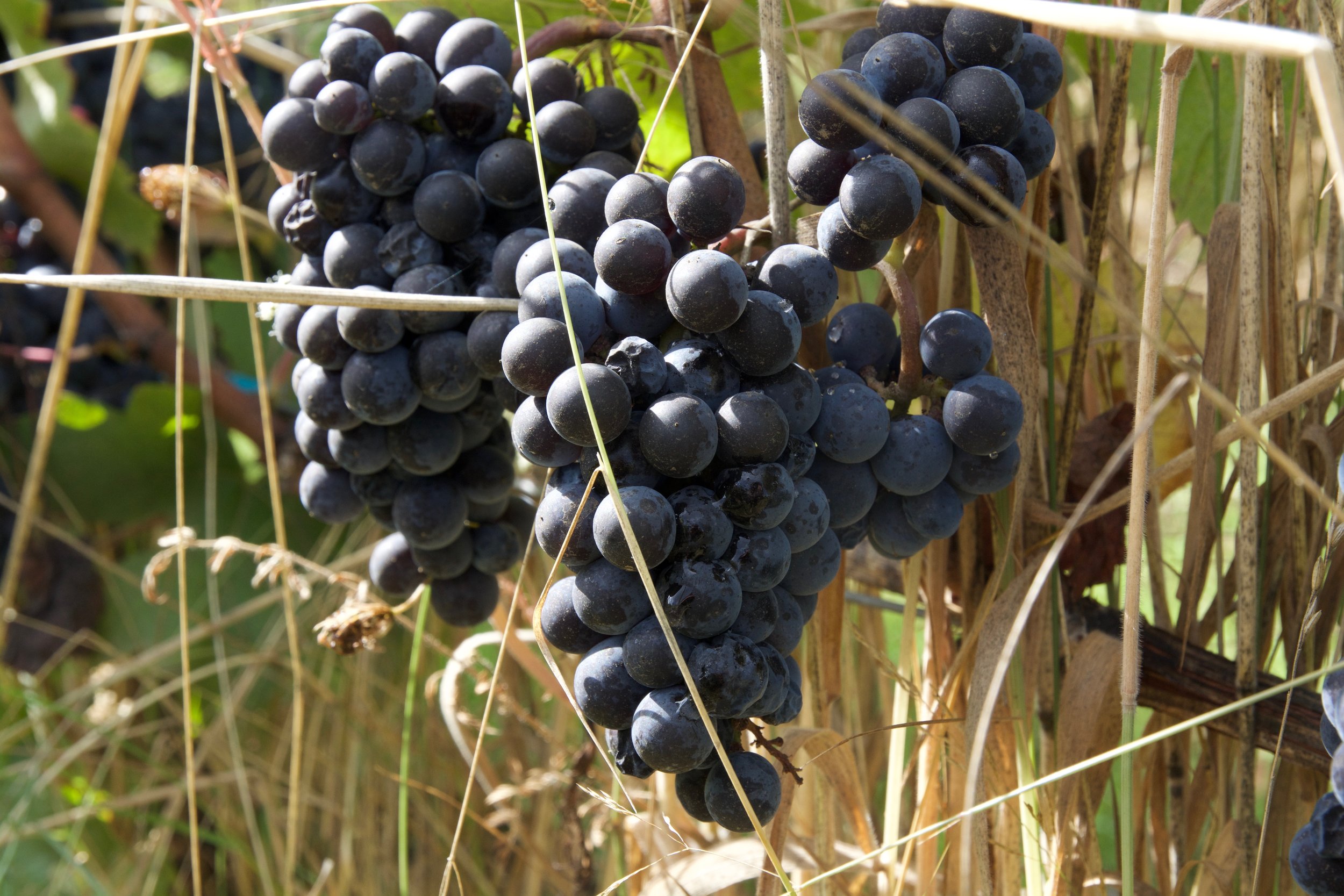
In October of 2017 I had the great pleasure of visiting Montinore Vineyards, producers of several wines carried by People’s Food Co-op. Montinore is a 200-acre vineyard estate that finds itself in the northernmost end of the Willamette Valley wine growing region, along the east facing slope of the Coastal Range, in the proximity of Forest Grove, Oregon. As a picture taking guest, my timing couldn't be worse, but I am treated to a full tour of the operation by friendly staff nonetheless. Dozens of workers are busy in the height of harvest season, working intently to harvest the perfectly juicy pinot noir grapes before an early winter storm arrives later in the week.

Much of the landscape of this estate is consistent with other wineries in the valley. Rolling, vine carpeted hillsides, stunning mountain views, and an ornate tasting room and production facility are all hallmarks of Oregon “wine tourism” that can be found here. But in the fields there is a much deeper, attentive care in farming practices that is happening, more than immediately meets the eye.

Planted in 1982, Montinore today is the second largest producer of estate grown certified Organic & Biodynamic grapes in the country. It is an impressive display of dedication and meticulous crop management that they are able to produce grapes this way, and still manufacture enough quantity to be distributed in multiple states.

Many people will be familiar with the core concepts of Organic farming, denoting that crops are not treated with artificially manufactured pesticides & herbicides. Biodynamic farming, however, is a less well known and truly fascinating farming technique, and not one commonly employed in winemaking in the United States. At its core, Biodynamic farming insists that the health of a farm occurs from the elements present within the farm itself. With creative applications of human intervention, contributions from animals, and the cycles of the earth, the workers at Montinore seek to harness natural forces in service of the vines.

Montinore does not water its vineyard at any point during the growing season. Employing “dry farming” techniques, the vine roots are encouraged to grow deep into the ground in search of retained moisture from the previous winter. In this way, the vine becomes stronger, and, according to the winemakers, extracts more complex flavors from the soil. Through this network of deep vines, it is believed that the grape is an expression of the geological history of the land.

Above the surface, Biodynamic farming at Montinore involves a variety of techniques both scientific and what some would call “mystical”. After the harvest, crops of clover are planted between the vines to augment nitrogen in the soil. Early in the spring, roses planted by the vines do their part to slow mildew before it has a chance to attack the vine. Goats that are raised on the property provide a critical ingredient of Biodynamic farming, their manure, which is cultivated into a “tea” inside of bull horns (seriously, look it up) and manufactured into a spray fertilizer. All of these things are done within the seasonal cycles of solstice and equinox when the gravitational pull of the moon ebbs and flows with the sap of the vine.

A highlight of my tour was the time spent in the tasting room, of course, where I was able to sample from the full array of Montinore’s commercial and estate selection of wines. At one point, two glasses of pinot noir were put in front of me. One was made from grapes grown at a slightly higher hillside elevation, and the other was from the lower lands of the property. It was explained that the soils of each of the vines were starkly different, with the lower elevation soil containing more elements of the Missoula Flood substrates. The contrast between the two was remarkable; both the same subspecies of vine, but with undeniably different expressions.

wines1.JPG

I invite you to try the Montinore products proudly featured at People’s Food Co-op. We are extremely fortunate to have such an incredible winery located so close to us, particularly one which embodies our Co-op Ends Statement of “Progressive Land & Animal Stewardship”.

Be sure to stop in to the Co-op on Saturday, January 13, 2-5pm, when Montinore will be doing an in store tasting! You can try all of the different Montinore wines we carry, including Verjus, a non-alcoholic pinot noir grape juice, and learn more about their farming estates!

Montinore Vineyards - Pinot Gris $12.49

Bright and fresh fruit with a zip of citrus zest. Clean and quaffable and great paired with grilled Vegetables.

Montinore Vineyards - Pinot Noir, SALE: $15.99, REG: $17.99

Best value Pinot Noir in Oregon! Plush red fruit, fine tannins and round texture. Delicious and balanced, and can pair with everything from savory slow cooked beans to fresh seasonal vegetables.

Montinore Vineyards - Almost Dry Riesling $13.99

Tropical aromas of exotic starfruit and mango swirl from the glass with notes of juicy honeydew. Tangerine, stone fruit, and key lime flavors are scented with mace and a hint of flintiness. Nice, clean acidity and dry on the finish. Great with a variety of foods or drunk on its own.

Last Minute Gift Ideas!

Last Minute Gift Ideas!

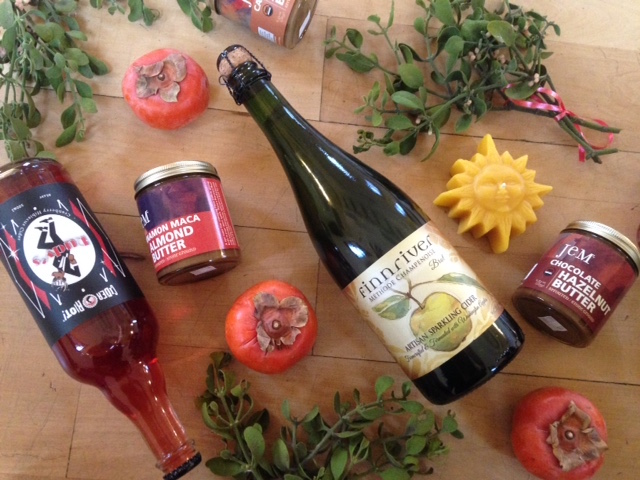
Need some inspiration for last-minute gifts? Here are some of our favorite little gems, most of which are locally made!

IMG_3269 (1).JPG

Casper Candles
Price: $7.99

Handmade in Eugene, Oregon, these 100% beeswax solstice candles are a People’s exclusive!

Juniper Ridge essential oils
ON SALE! $7.99-$9.99

Juniper Ridge wildcrafts their incredible essential oils from plants native to the West Coast region. Based in Oakland, California, their products are made using old perfume making techniques including distillation, tincturing, infusion and enfleurage. Some favorite fragrances include Cascade Forest, Redwood Mist, and White Sage.

Jem nut butters
ON SALE! $10.99

Made in Bend, Oregon, these organic, stone-ground nut butters are delicious and unique. Some favorite flavors are cinnamon maca almond butter and cashew cardamom almond butter.

Jem Spreads.jpg

Honey Mama's
Price: $5.99

These Portland-made chocolates are a dreamy treat that’s sure to delight the chocolate-lovers in your life! Honey Mama’s bars are raw, honey-sweetened cocoa treats made from only five nutrient-rich ingredients! They’re also direct–trade, organic, and non–GMO to boot.

Cobb’s Cups
Price: $3.29

Cobb’s chocolate cups taste like they were made by magical woodland pixies. With flavors like walnut, fennel pollen and lemon-myrtle extract, topped with toasted buckwheat groats, these tiny treats are surprising and scrumptious! Made with mostly organic ingredients in Olympia, Washington.

Persimmons
ON SALE! 2 for $2.50

The last local persimmons of the season were grown only a few miles away from the Co-op, in Northeast Portland! Sweet, flavorful and beautiful, get them while they last!

IMG_3243.JPG

Clementines
Price: $2.49/lb

These sweet and juicy Clementines are grown in California. They have fewer seeds and are more full-flavored than Satsumas, and make a wonderful winter treat.

Mistletoe
Price: $3.99

Hang in the doorway for another fun way to kiss your sweetie, or simply enjoy this seasonal plant as a lovely decoration! Locally grown in Ashland, Oregon.

Regional Snack Blend
Price: $21.99/lb

This all-organic trail mix is found in our Bulk section, and makes a wonderful gift for the hikers and snackers in your life! Made with locally grown cranberries, roasted hazelnuts, bing cherries, apples, pistachios, almonds, flame raisins, walnuts, pepitas and persimmons, this is a delicious and nutrition-packed treat.

IMG_3272.JPG

Cider Riot! Rudy Cranberry Hibiscus Cider
ON SALE! $6.79  

Rudy's Cranberry Hibiscus is a dry, refreshing cider fermented from local apples blended with Starvation Alley cold-pressed organic cranberry juice from Long Beach, Washington, then aged on organic hibiscus flowers. The cranberry gives the cider a bright, crisp tartness, while the hibiscus flowers provide an earthy, balanced overtone of tannic flavor and floral aroma.

Finnriver: Seasonal Botanical Cranberry Rosehip Cider
Price: $9.79

Finnriver's winter seasonal cider is a Cranberry Rosehip blend featuring a lively fermented apple base with tart, organic cranberries and wildcrafted rosehips from the Olympic Peninsula. Celebrate the season with the succulent herbal notes and crimson color of this semi-sweet craft cider.

And remember that when you mix and match any 6 bottles of wine, beer, or cider, you save 20%!  A great way to stock up for the holidays and try something new!

e526f07e-0762-41bc-b31a-f7f498a29f81.jpg

Bounty Baskets

The application period for bounty baskets has closed.

For those in our community that need support this November, People’s Food Co-op and some of our vendors have partnered to provide 80 free vegetarian food baskets.

We donate these baskets every November to support those with limited access to healthful foods. Around Thanksgiving especially, we are called to address the harm caused by colonization. Settler colonialism and white supremacy limits many of our community members' access to resources, and we aim to share the abundance and generosity of our vendors to directly support those at the intersections of these oppressions this time of year. This work fulfills our Ends of social/economic justice and progressive land stewardship.

Bounty Baskets are reserved on a first come, first served basis every year. Before applying for a basket, we ask that our community members assess their need in relation to how they may be harmed by or benefit from white supremacy.

Basket pick-up will be on Wednesday November 22nd from 4-7pm in the Community Room. The Community Room is located up a flight of stairs. it is accessible by elevator lift as well – just let a cashier know that you need to use it and they will help you.

Only 80 baskets are available, and sign-ups are recorded in the order they arrive. Baskets are limited to one per household. A link to the online application is available at the top of this post, and paper applications are available at the register. After all baskets are spoken for we will create a wait list. You will be notified by Thursday, November 16th if you will receive a basket.

Food baskets are designed to feed about 4 people and will likely include:

  • Organic produce: yams, potatoes, squash, onions, garlic, greens, apples

  • One pie crust & one can of pumpkin pie mix

  • $10 voucher for the People’s Farmers Market on Wednesdays 2-7pm

  • Other food items: 1 can cranberry jelly, vegetable bouillon cubes, a loaf of bread, and Three Sisters Nixtamal tortillas

Basket contents may change slightly. If you have any questions, please email marketing_membership@peoples.coop. If you need any help in filling out an application, please feel free to call the co-op, and a worker will walk you through the application.
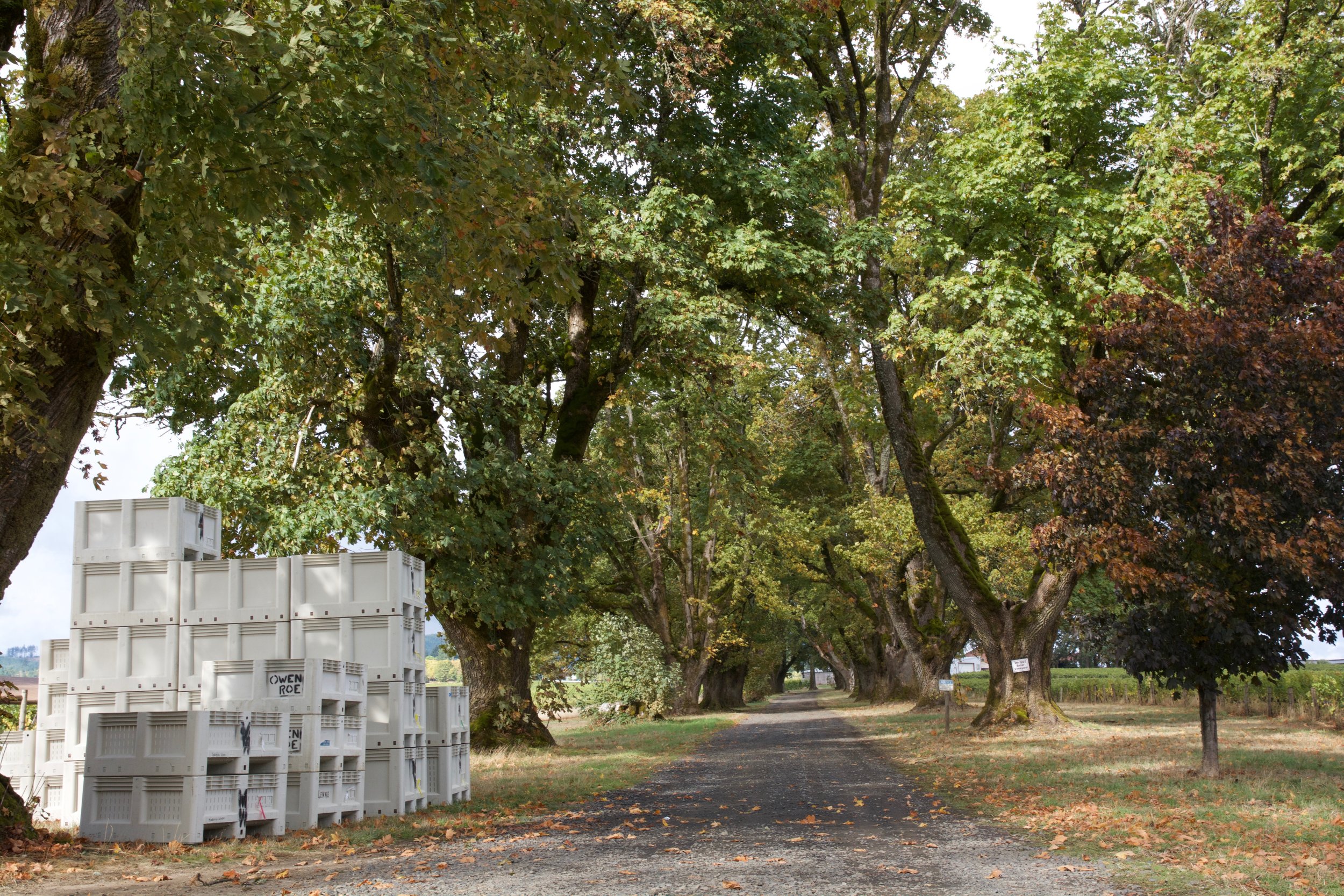
Many thanks to our generous vendors who donated! We couldn’t do this without them.

Featured in November: Organic Wines!

by Ryan Gaughn, Alcohol Buyer

November is one of my favorite months because it's a time to get together with friends and family and share incredible food.  Whether it's root vegetables, rice pilafs, stews, pies, or casseroles, there is one ingredient that most of these cozy meals are really enhanced by: WINE.  And, this November at People's, I've curated some organic reds and whites for your feasting table, wine which can be easily shared without breaking the bank.

Organic wines are an intriguing thing.  Many of the wines we carry at People's are produced using grapes from vineyards which employ organic & biodynamic agricultural practices.  Indeed, the vast majority of winemakers avoid the use of synthetic pesticides, herbicides, and fertilizers as much as possible, because they are intimately aware of the negative effects these products have on the vines.  

However, you don't see wines that are certified USDA Organic very often.  This is because the USDA Organic certification standards prohibit the addition of sulfites in the winemaking process.  Human-produced sulfites, which are considered to be non-naturally occurring by the USDA, are commonly used as a preservative in the vast majority of wines that are produced throughout the world.  Wine often is shipped great distances, and stored for longer periods of time than most food products, hence the use of sulfites provides a means for producers to ensure the quality of their product long after it has left the winery.

At People's we carry both choices.  We have USDA Organic certified reds, such as the Pacific Redwood Red Blend ($9.99), and Frey's Agriculturist Red ($11.79), which are a part of the no sulfites added camp.  And then there are other wines we're featuring which feature organically grown grapes, such as the Montinore Pinot Gris ($12.49), and the Old Vine 11 Pinos ($9.99), which are not certified organic, again, primarily because of the use of sulfites.

There is a range of debate about the pros and cons of adding sulfites to wine.  Some people don't think it makes a difference, while others find that non-sulphited wines have a tendency to lose freshness more quickly if not consumed immediately after opening.  I often hear some customers say that wines with added sulfites give them a headache.  Others think that has more to do with the alcohol.....

This November, I encourage you to keep the co-op in mind for all of your holiday feasting ingredients.  Especially wine!  We have a great range of selection, and, when you mix and match any six bottles, you save 20%!  Come on down and try out some new organic wines, and be sure to ask for me, Ryan, if you're looking for a recommendation.  I love to talk about our selection and alcohol production in general.  I'd be delighted to help you find something that will suit your needs.

October is Co-op Month!

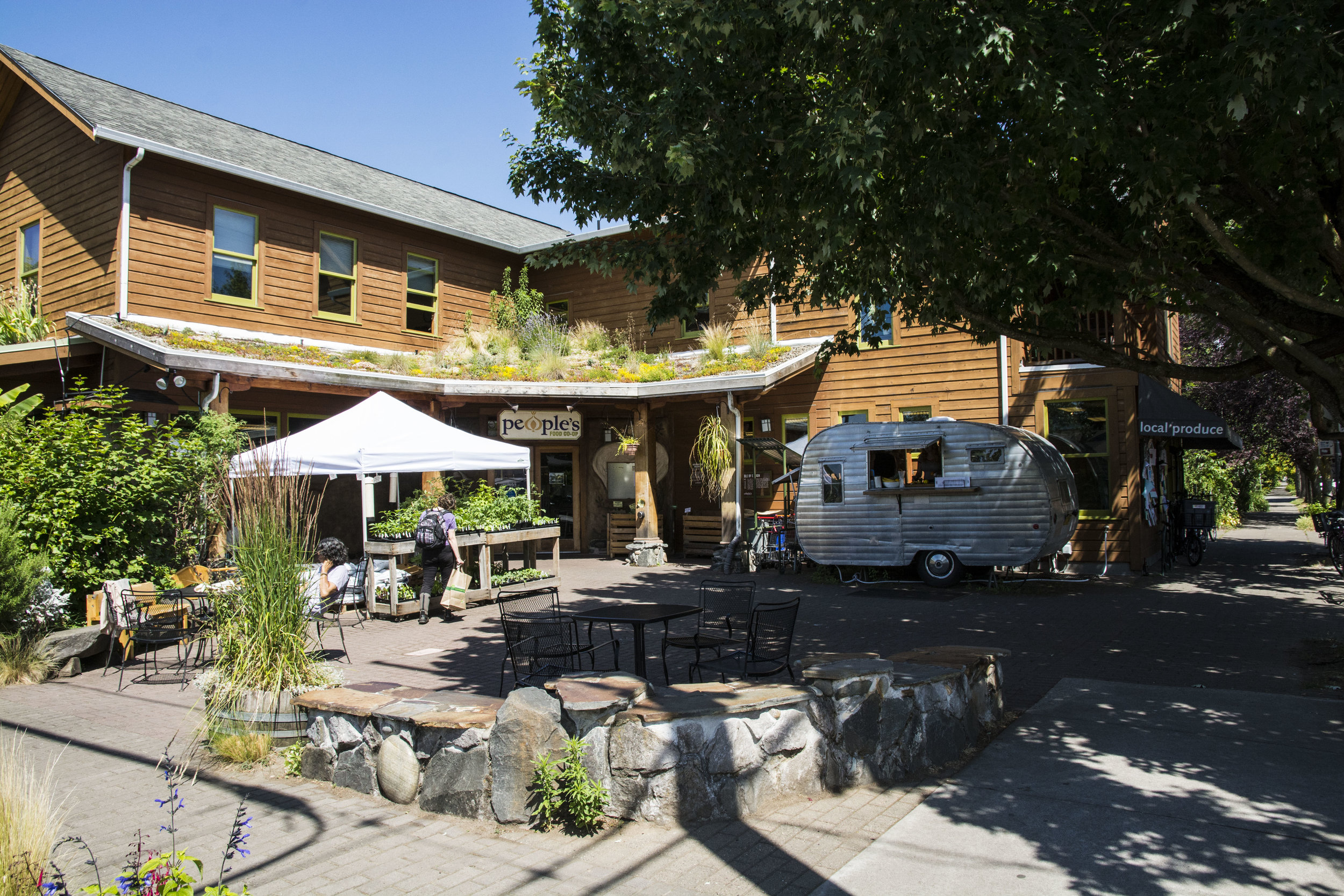
storefront.JPG

Come celebrate with us!

People’s is special. In an industry aiming to squeeze every dollar out of every customer and sell you things you don’t need, our goals are a little different. We’re here to serve our community great food grown in a way that’s environmentally sustainable and cares for the land and the people that grew it while working to find prices that work for producer and consumer. We’re here to cultivate a passionate community and to talk about the values that bring us to this particular food store.

We can do all of that because of our Member-Owners: folks who care about what we’re doing together and want to see this place thrive. Investments from Member-Owners are what help us take care of this building, invest in new equipment and programs, and are positioning us to grow our Co-op and our impact with the long-term plan.

Becoming a Member-Owner is very easy and, during Co-op Month, making an investment is super fun! Invest to get these great incentives:

  • $15+ Get an Equal Exchange Chocolate Bar!

  • $30+ Chocolate + a People’s Tea Towel designed by local artist Subin Yang!(check out the illustration at the top of this post!)

  • $60+ Chocolate + Tea Towel + a Chinook Book!

DSC_0703.jpg

And!

  • The first fifty folks that make an investment in their share get a free bottle of co-op grown and made La Riojana Olive Oil!
  • Every Sunday in October, we’ll have a really awesome raffle! Everyone who makes an investment in their share will be automatically entered (but you don't have to make an investment to be part of the raffle). 
  • In your Grassroots, you got a special coupon along with your quarterly 10% off. Write your name and Member-Owner number on the card, hand it to a friend who you think should become a Member-Owner, and when they do you'll both get $10 gift cards! 

We're also having a ton of great events to celebrate the Co-op and our Member-Owner, from awesome sales on staff favorites to a community potluck. Check out all our upcoming events here

The full price of a share in the Co-op is $180, but Member-Owners get all the benefits of membership as soon as they invest $30 in the Co-op. Member-Owners can actually invest up to $300 at the Co-op, so if you’re already at $180 and want to support the Co-op a little extra you can still get this year’s great incentives.

Join the Co-op

Understanding Gendering: Small Changes to Make the Co-op A Safer Place

By Comanagers Finnley LoPresti, Devon Deering, & Sailor Winkelman

While checking out at People’s registers, you may be taking note of signs requesting: “Please refrain from gendering us. We appreciate it.” The signs are small, but have a big impact for staff members, Hands-on-Owners, and members of our community. Here, we try to tell you more about what “gendering” means, how it affects workers and community members, and how cultivating awareness around this is in alignment and activation of our Ends.

What is “gendering?”

Gender is deeply embedded in the language and interactions of our culture. It is common to use words like “miss,” “sir,” “ma’am,” “she,” “he,” “lady,” “man,” to describe a person. This is called gendering, because the language communicates about the gender of the person being spoken about, or to.

While we live in a culture in which some physical traits, personality traits, interests, or behaviors are often thought of to belong to a certain gender, a person’s gender identity is not something we can know based on observing any of these things. Gender is a very personal, internal experience of one’s identity and sense of self. Therefore, if we use gendered language to describe a person without knowing how they identify, it is very possible that we’re misgendering them – or calling them by a gender other than how they identify.

What is the impact of misgendering at the co-op?

Your authors are staff members at Peoples, are people who experience being misgendered regularly, sometimes many times a day. It is painful and frustrating every time. The effects of repeated misgendering during a shift, work-week, and years of working are profound. Quality of life, emotional well-being, and job security are just some examples of things that are impacted by repeated misgendering for customer service workers. We recognize that shoppers, Member-Owners, and members of our community are also affected by misgendering, and we want to extend our effort to create a more supportive culture to all who share space with us.

How can we avoid misgendering people?

What we are asking for are small changes to everyday language, which cultivate respect and inclusion of people of all gender identities.

1. Use gender-neutral language for people you don’t know.

Working in the store, we do not expect to get to know every person who comes through (though that would be nice!). We don’t expect everyone to know us, either. The expectation we would like to set for one another is to use gender-neutral language when addressing or describing a person whose gender you don’t know, keeping in mind that gender is something we don’t know just from looking at someone. We compiled a small chart to show some ways to replace frequently used gendered language with gender-neutral language:

Screen Shot 2017-08-18 at 1.00.18 PM.png


2.  Ask for a person’s pronouns as a part of getting to know someone new.

While we encourage gender-neutral language to avoid misgendering strangers, we often do get to know each other better. When meeting a new person, for example during a class, or volunteering together, we encourage you to ask their pronouns, and to introduce yourself with yours. Pronouns are words like “he,” “she,” and “they.”

Here’s a sample dialogue:

Person A: Hi, my name is Julie.

Person B: Hi Julie, my name is Sam.

Person A: Hi Sam. What are your pronouns.

Person B: They/Them

Person A: Ok. Mine are She/Her. Nice to meet you!

Sam and Julie can avoid misgendering one another, because they had a conversation about what pronouns work for each person.  

3.  Question your assumptions about gender.

Both using gender neutral language, and making gender part of the conversation when meeting someone new rely on questioning the assumptions about gender that we have been exposed to from the dominant culture.

We encourage you to reflect on how this cultural shift could put us more in line with the Ends Statement, which informs the work we do at the Co-op. As “a passionate community working together for human rights, social and economic justice,” it is in line with our Ends Statement to cultivate awareness around oppressive systems, and hear each other’s experiences within them. By practicing gender-neutral language in the Co-op and community, we participate in dismantling cultural norms that exclude and harm people of all gender identities. This is one of the many ways that our awareness and work help to create “a safe, welcoming community where all are valued.” By questioning our assumptions about the gender of people we do not know, our hope is that in doing so we can help make the Co-op, community, culture, and perhaps even the world at large a safer and more inclusive place for folks of all gender identities.


Process Update: Moving Forward Together


As we outlined in a previous blog post, the Collective met yesterday (Thursday, August 10th) to talk more about our long-term planning process. The original goal of this meeting was for the Collective to come to alignment on where to focus our engagement with Member-Owners going forward: either relocating in the neighborhood or opening a second store. 

Because of the feedback that we received from Member-Owners and some new information from our feasibility research, the Collective did not narrow down or rank the potential projects that are on the table. We spent the majority of the meeting talking about what getting meaningful engagement and feedback from the community looks like and how it will factor into a decision. We will be working to revise our process map and creating a comprehensive plan to allow for abundant Member-Owner input going forward. 

Also as a part of the meeting, we spent some time in small groups brainstorming new and innovative ways that the Co-op could adapt the plans on the table to be more financially viable (a clear need arising from our feasibility research) as well as fulfilling community needs that we haven't actively considered up to this point. 

We also spent some time sharing perspectives about what the last few weeks have been like for folks on the Collective: what feedback they've heard, what they've been wrestling with, what emotions have come up for them, as well as how we're generally very encouraged by the participation and passion of our Member-Owners. 

This meeting brought us to a pretty open place in terms of what our next steps are. We're in the process of planning a community forum so that we can hear from more community members and also share some information with you all -- plan to hear an announcement about that very soon. We're also planning more feedback sessions in September and opening them up to more people (though still keeping them small enough to have meaningful conversations -- we're planning to cap them at 20 folks). We'll save conversations with vendors and other community stakeholders until we have a clearer idea of what our plan is.

We're not putting this planning process on pause, but we are making space for more research and more input from our community. At the same time, we're actively tending to our financial responsibility to the Co-op given the expense of this process. 

If you have questions, input, or ideas that you'd like to share, you can send them to the Long-term Planning Committee at planning@peoples.coop. You can also get in touch with the Board of Directors at bod@peoples.coop. For more framing about our planning process and a catalogue of past blog posts and articles, check out people.coop/vision. 

From the Board: Our Special Meeting

Dear Member-Owners,

The Board of Directors (Board) and the Long Term Planning Committee (LTPC) have received many comments over the last few days regarding the nature of Member-Owner involvement in considering any specific expansion plan and the long term sustainability of the Co-op.  In an unprecedented action, the Board and the LTPC convened a special Board meeting on Tuesday,  August 8th. Nearly all Board members and the full LTPC were in attendance, and were joined by three Member-Owners, who were able to participate in a portion of the meeting and share their concerns.

This letter is one of the results of the special Board meeting and its purpose is to provide an overview of why we are planning for the Co-op’s future, what that process has looked like thus far, and what it will look like going forward.

The Co-op has been in a long-term planning process for over three years. This work began at the urging of the Board in 2014, when it was clear that the Co-op needed a directive for how to stay resilient in a changing Portland. Sales were flat, in 2014 patronage wasn’t paid out for the first time since the Co-op adopted the patronage system, and competition in the natural foods industry was only increasing, as it still is today. However, despite being a Co-op-mandated policy-governance reporting requirement, the Collective Management (CM) did not have a strategic plan for the Co-op’s future at that time. And that’s where this whole process originated -- from a clear need to address the growth and sustainability of People’s to ensure that our Co-op has a future.

Over the past two years, the LTPC has been creating that strategic, long-term plan. They held community events engaging Member-Owners around our collective vision for the future, did research into different growth possibilities, and engaged experts to gather market data and other information that will help ensure that any decisions we make  will be fiscally sound, as well as reflective of our Ends. Throughout this process, the LTPC reported to both the CM and the Board to keep the planning process in check.

We’ve come to the place where we’ve narrowed the possibilities to a couple clear options: (1) relocate to a larger location in inner SE - while keeping our current building and doing something in pursuit of our Ends here, or (2) open a second store in Lents, Milwaukie, or Montavilla. These options inadvertently became public as a result of a market study conducted in July, and were discussed with Member-Owners at our Annual Meeting on July 15th. (You can read more about that here.)

Now it’s time for us to discuss how to make a decision so that we can move forward, and stay competitive and responsive to our community’s needs. This will include outreach to the membership to inform our options and get more feedback. Events and surveys will happen in the next few months, after which a decision will be made.

The Board and the CM have already heard from a lot of Member-Owners about these plans. Some are excited about the ways that the Co-op might grow and some are very concerned that our current store might close. Many are concerned about how these decisions will be made.

It became clear to members of the Board and the LTPC that a special meeting was necessary in order to answer questions, gain clarity on the input that’s been received, and to hold space for the feelings alive in our community. Unfortunately, we were not able to broadcast this meeting to the entire Member-Ownership because of its last-minute nature.  This is the first time that a special meeting has been called on such short notice in as long as anyone can remember.

We understand that the Co-op is on the precipice of something really big, and that we collectively need to be looking closely at this decision and the process from a wide variety of perspectives.  

Stay tuned for more ways to lend your input as we move into the fall. The LTPC will be holding info and feedback sessions, possibly conducting an electronic survey, as well as holding other special informational and engagement events as part of the decision-making process. Please be in touch with the LTPC if you would like to be involved. For more details about overall the planning process, see peoples.coop/vision.

If you have any questions or concerns, please be in touch with the Board at bod@peoples.coop and the LTPC at planning@peoples.coop. We look forward to talking more with you as things move forward, and hope to see you at upcoming Board meetings and events!

Cooperatively,

The Board of Directors

How We're Deciding: The Long-term Planning Decision Making Process

With the recently announced long-term planning proposals, a lot of Member-Owners have been asking how decisions about our long-term plan will be made, and how decisions are made at the Co-op in general.

Broadly speaking, the Board (elected by you, our Member-Owners) has delegated operational decisions to the Collective Management, a group of about thirty staff members who work in teams and as a whole to run the store. Operational decisions include everything from the products we carry, to worker health care benefits, to the annual budget, to what events we hold, and so much more. The Board's job is to ensure the Co-op is run in a way that is financially responsible, legally sound, and in line with our Ends. The Board keeps tabs on how the Collective and the Co-op are doing via reports about a variety of things: our Ends, financials, our public image, staff satisfaction, and more. To ensure that communication is clear and ongoing, three Collective Managers are currently tasked with providing a link between the Collective and the Board. Additionally, one Collective Manager also serves on the Board of Directors. Of course, Collective Managers and Board directors have individual and positional relationships that encourage other communication and conversations, too.

Included in this, the Board has delegated the decisions regarding growth and expansion to the Collective within certain parameters: that the process takes Member-Owner input into account, that the project is researched for financial feasibility and meets particular financial benchmarks, that the Collective engages appropriate experts outside of the Co-op to support our process and inform our decision, and that our long-term plan advances the Co-op's work towards our Ends.

If the plan or the planning process doesn't meet those qualifications, the Board can require the Collective Management to re-evaluate or change directions in order to fulfill them. The Board also has jurisdiction over real estate acquisitions and any major loans that the Co-op takes on. This means that ultimately they have to be on board with any major plan that the Collective generates in order for it to be able to be implemented.

The long-term planning process that we're currently engaged in started two years ago with the formation of the Long-term Planning Committee. The Committee was charged with investigating how the Co-op could grow in order to move us towards our Ends, but also to address issues arising at the Co-op: that we're maxing out our space which has resulted in low sales growth and that space is tight for customers and staff, among other reasons. (You can read more about that here.)

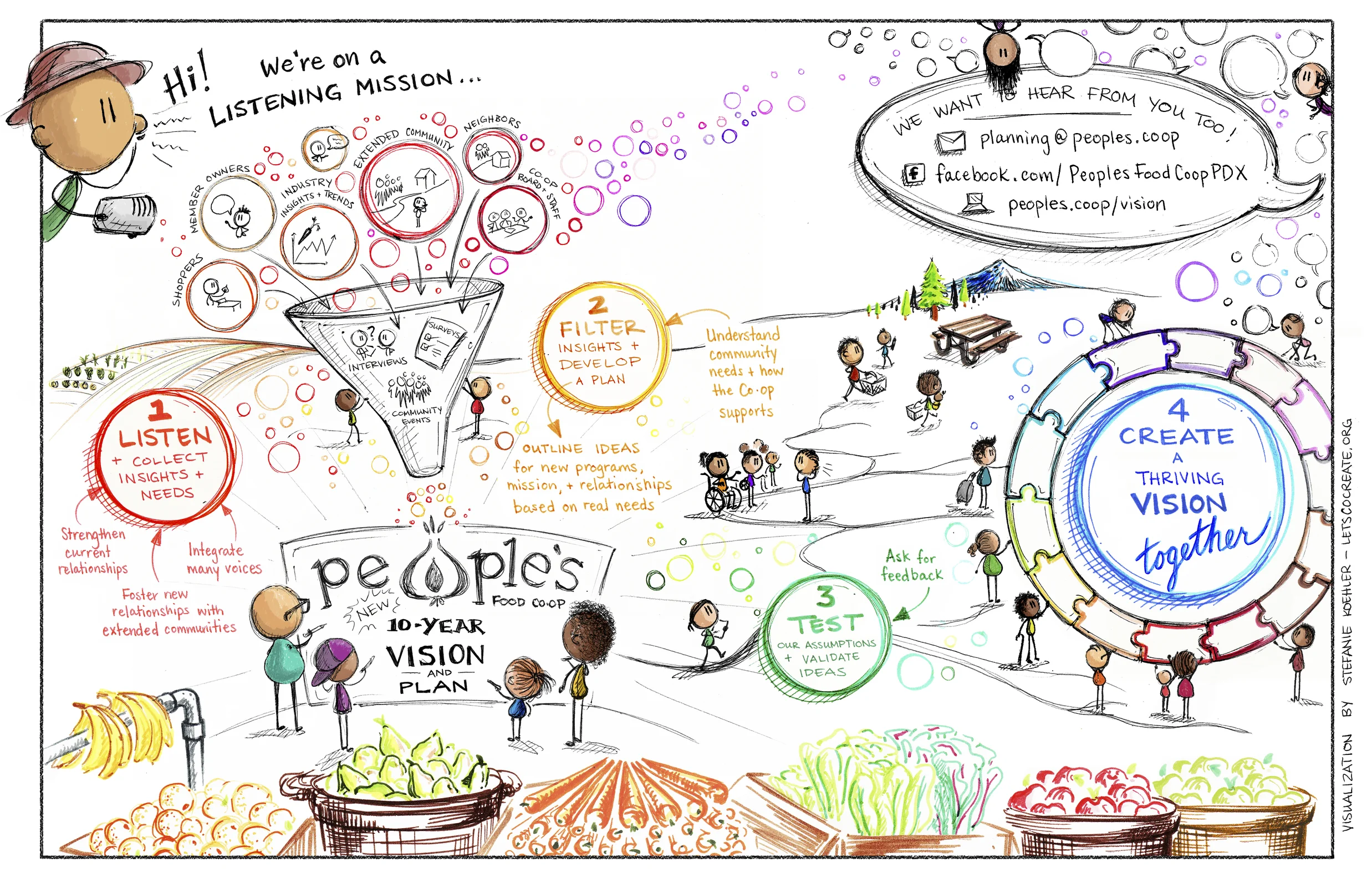
Our original process map outlines how we're making the decision about our plan! We're almost to Step 4!

Our original process map outlines how we're making the decision about our plan! We're almost to Step 4!

To kick off our research of potential projects, the Long-term Planning Committee organized a series of listening sessions with Member-Owners and community members to hear what their priorities for the Co-op were. There was also space for Member-Owners to share their biggest, wildest dreams for the Co-op as well as what their particular needs from the Co-op are. We also conducted interviews with a number of community organizations (OSALT, Adelante Mujeres, Sisters of the Road, the Portland Mercado, and the Healthy Birth Initiative) that are also doing work towards our Ends to hear about any gaps that might exist that the Co-op would be able to fill. We also surveyed vendors and farmers.

We took the information that we heard during those outreach sessions and came up with some concrete ideas of what long-term projects the Co-op could undertake. As we were narrowing down our ideas, we did so in conversation with the Board of Directors to keep them apprised of our choices. We also had conversations with the Collective and the Board about what might actually be feasible -- financially, logistically, and in terms of our staff capacity.

Not unexpectedly, all of our ideas included expanding our grocery store. After all, running a grocery store is our expertise and increasing our sales is a major way to work on our financial feasibility. From that narrowing by the Collective, the Long-term Planning Committee started to research where else we might be able to open another location in the Portland area. We looked at where our competitors are located or have planned locations, followed leads suggested by Member-Owners and other community members, and talked to lots of folks: community groups and organizations, business associations, nonprofits, city planners, other business owners, and more. We also invited National Cooperative Grocers to do an organizational readiness assessment at People’s and make suggestions. This process narrowed our expansion options to Montavilla, Milwaukie, Lents, as well as relocating to a larger location in our current neighborhood. We enlisted a market research company out of Seattle to look closer at those neighborhoods in terms of their financial capacity to support a new or larger co-op.

Throughout this process, the Long-term Planning Committee has been in conversation with the Board of Directors, bouncing ideas off of them and talking about what the implications of different plans might be for the Co-op and our Member-Owners. We’ve also been really open to other feedback from Member-Owners throughout the process, fielding emails and suggestions -- especially with the recent news break about our narrowed project ideas. We really do want to hear from you, really do value your input, and certainly respect the stake that our Member-Owners have in this business.

So, to summarize:

  • Our Member-Owners and broader community provided their dreams and needs for the co-op

  • The Collective Management figured out how those dreams and needs can be met in a way that’s feasible for the Co-op in the long-term, with guidance and boundaries from the Board, while also addressing our primary reasons for creating this long-term plan.

That brings us to where we are at now! In the next few weeks, the Collective Management will meet to make a final decision about which development project we’re going to pursue: opening a second store in one of the neighborhoods we’ve narrowed to, or relocating to a larger location near our current store. Once we make that decision, we’ll talk more with the Board. We’re also working on organizing feedback sessions for Member-Owners to share their reactions and hear more about the Collective’s decision-making process. We’ll hold at least two of these with twelve Member-Owners each, chosen randomly from folks that express interest in participating (email us at planning@peoples.coop if you’re interested, too). We’ll also have online surveys for folks that want to provide feedback but can’t make it to one of the sessions. We’re planning a third feedback session with other stakeholders, including other members of the co-op community in Portland. These meetings (and all of the other ways that we hear from Member-Owners) will help us to figure out whether we’re on the right track. From there, we’re aiming to make a big formal announcement in the fall Grassroots in October and kick of Co-op Month celebrating that we have a plan (finally!) and talk to more Member-Owners about it.

That’s when implementation starts: working hard to find a location for a new store (whether that’ll be a 2nd store or single larger store) that will meet our practical needs and be as much of an anchor in our community as our current building is; planning a fundraising campaign and seeking loans; figuring out how to grow our staff and maintain our Collective while becoming more nimble and efficient; working out what new things will be in our new space (a deli? a cafe? a bakery?); and so many other details. We’ll need your help with lots of that, and know that this passionate community is ultimately what grounds us and moves us towards our Ends.

Our aim has always been to be transparent and open with our Member-Owners. We know that this process has taken a long time, and that a lot of you have probably been waiting for information and affirmation that you’re central to what we’re doing here. It’s been hard for us, too, that this has taken so long. But we’re moving through the planning process, and we’re beginning to work out the details of our plan. Upcoming phases of our expansion will also be hard and they will also probably take longer than we want them to.

This is also really, really exciting, though. We’re taking this big step together, in an effort to move us toward our Ends and to keep the Co-op viable for another 50 years. What we’re doing at the Co-op is really important, and has started to feel even more crucial lately: we -- this community of Member-Owners -- are providing terrific food to our community, in a way that advocates for the land, animals, farmers, workers, and eaters throughout the food system. We’re doing this not to make profit, but to provide a service to our community and an alternative to corporate business-as-usual. That’s important, compelling work that we can only keep doing if we figure out a way to grow together. That’s what this long-term plan is for.

So, let’s talk about it! If you have any questions or want any clarification, we really urge you to be in touch with the Long-term Planning Committee at planning@peoples.coop. Please let us know, too, if you are interested in being a part of our feedback sessions in September. Here’s another recent blog post with updates about the options that we are currently considering. If you want more context about why the Co-op is talking about expanding, check out peoples.coop/vision and always feel free to be in touch with the Long-term Planning Committee by emailing planning@poeples.coop. A reminder that Member-Owners are also always invited to attend Board of Directors meetings, which happen on the 4th Tuesday of the month at 6pm, with free dinner starting at 5:30pm.